Tuesday, June 8, 2010

Janespotting: Mansfield Park (1983 miniseries)

I wasn't sure I was going to be able to get my hands on this earliest adaptation of Mansfield Park, but I decided to give Netflix a try and see how many of these oldies I could get within the one-month trial membership. This BBC production is an extremely faithful version of Austen's novel, told over six one-hour episodes. With early 1980s production values, however, might not necessarily be a good thing.

The plot certainly didn't veer far from the original novel. We see Fanny introduced to Mansfield Park, her growing friendship with Edmund, and the changes wrought by the arrival of the Crawfords. All the little amusing details are there, including how Aunt Norris initiated Fanny's arrival but claimed she never intended to raise her herself; the ridiculousness of Maria's fiance Mr. Rushworth (and his 42 speeches); Fanny's return to Portsmouth and how she makes things quieter by buying her younger sister a pair of silver scissors. Unfortunately, all the tedious and boring details are there as well, but without the benefit of footnotes to explain for the viewer. Honestly, you'd think that the screenwriter transposing the scene where the young people discuss which parts they should portray in the drama Lover's Vow might intersperse one line here or there so that we understand what it means for Maria and Julia to battle over playing Agatha. There's nothing, though, so the five-minute discussion of a play few modern viewers know is tedious beyond belief. There are similar slow spots, not helped at all by the era's avoidance of musical scoring except in transitions.

Still, the scenery and costumes were fine, and the acting was uniformly good. I recognized few of the actors, most of whom have gone on to long careers in British television and film. (The one exception: the actress playing Maria Bertram, Samantha Bond, played Miss Moneypenny in the various Pierce Brosnan-starring James Bond films.) The actress playing Fanny, Sylvestra Le Touzel, might have been made up a little more plainly than I would have liked (Sir Thomas remarks on his return she is uncommonly improved), but she captured Fanny's quiet steadfastness. The actress playing Lady Bertram was a hoot, and the actor playing Edward was pleasant enough.

My main dissatisfaction with this version, aside from the slow spots, was in the romantic conclusion of the film. There it had to vary from the original, for as I wrote in my review, Austen shows nothing of Fanny and Edmund's declaration of their love for each other. She merely says that "he was very steadily earnest in the pursuit of the blessing [of her hand in marriage], and it was not possible that encouragement from her should be long wanting." Given that setup, why not show Edmund being steadily earnest, or Fanny "receiving the assurance of that affection of which she [had] scarcely allowed herself to entertain a hope." Nope. In a major change from the book, where Fanny and Edmund witness Mary Crawford's shocking nonchalance towards Maria's affair firsthand, Edmund instead tells Fanny of Mary's faulty moral understanding and tells her he is glad she is there to listen. Fanny replies that she shall always be there, and that's that. No declaration of feelings. No proposal. No fun!

So overall, a pleasant-enough version of the story, and a good object lesson on why it's sometimes good to deviate from the novel to write your script. This will not be the case for the next version I'll be reviewing, but you'll see more on that later.

Monday, June 7, 2010

Photo of the Week--6/7/10

Not many pigeons in Gibraltar in January, but there were plenty of the famous and misnamed Barbary Apes, which are actually monkeys, specifically macaques. As you can see, they are not afraid of humans at all, so we got quite a few shots up close—but not too close, for safety's sake. We didn't try chasing them, since that's not the safest thing to do and besides, they were more liable to chase you. I wish I could have gotten a shot as we were walking from the top of the rock, where several of the monkeys were riding atop a van ... maybe they thought we were the vermin who needed to be chased out of the picture!

Friday, June 4, 2010

The Quilt Files, Episode 21

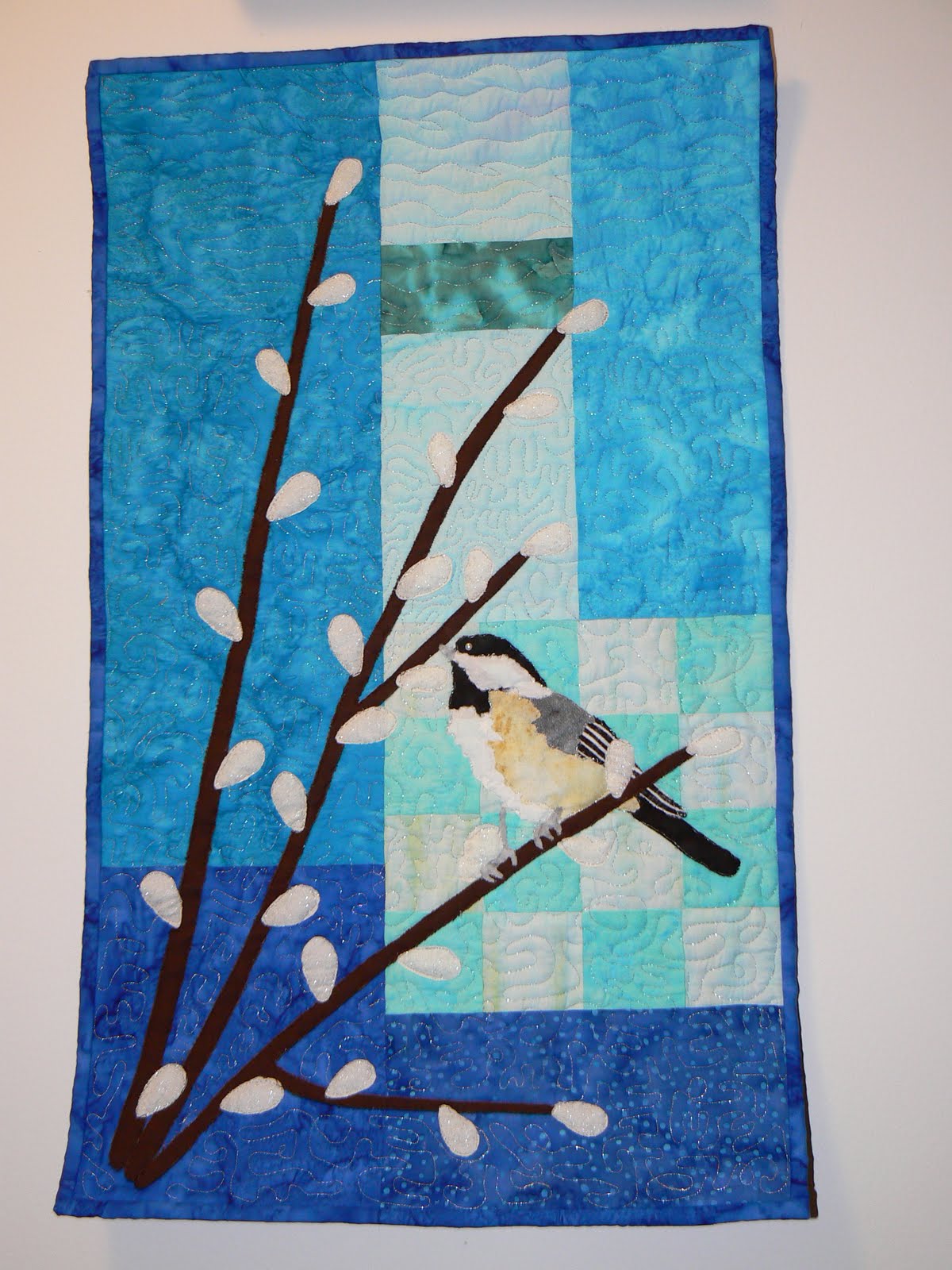
I'm always thinking ahead when it comes to gifts for holidays and birthdays. If I see something I think someone in my family will like, I snap it up even if the appropriate occasion is six months away. When I saw this pattern in the Keepsake Quilting catalog, I knew my mom would like it. I also knew exactly where she could put it (always something to consider when gifting something that hangs on a wall), especially if I changed the color scheme from the pattern picture.

The original pattern, for a chickadee sitting on a pussy willow branch, was pictured on an olive and brown-colored background. Blech. I'm not big on earth tones, as is evident to anyone who knows me; besides, my mom's newly remodeled kitchen bathroom had royal blue as one of the most prominent colors. So I raided the stash I had left over from my nephew's aqua-blue quilt, added a couple of scraps, and came up with the following:

Isn't that nicer than olive and brown—after all, the sky is blue, isn't it? The applique was simpler than it looks, because I left the edges raw. I could do that because a wall hanging isn't intended to be handled, so there was no need to create clean edges by folding them under and hand stitching. I didn't even need to protect the raw edges with heavy satin stitching, I just captured all the edges when I machine quilted the piece. The white fabric I used for the pussy willow blossoms had silver flecks in it, so I decided to use a silver metallic thread for the quilting. I stippled most of the background, although you might be able to tell that I tried to create a cirrus cloud-like wave pattern near the top. A friend who creates beaded jewelry gave me a tiny pearl for the chickadee's eye for the finishing touch. Here it is in detail:

It may not be the most finished-looking applique I've ever done, but I think the overall result came out pretty well. It really didn't take very long to put the whole thing together, but I was really pleased with the result. It made a very nice Mother's Day gift.

Wednesday, June 2, 2010

Janespotting: Version and Diversion by Judith Terry

This is the last of the Mansfield Park sequels I could lay my hands on, and I was intrigued because it was written by a professor of English who seems to have more than a passing knowledge of Austen; at least, she has had articles published in the journal of JASNA (Jane Austen Society of North America). And the premise looked interesting: a "below-stairs" portrayal of Mansfield Park, told by a ladies' maid who serves the Bertam sisters.

Our narrator introduces the story as her own personal history, writing in the present as the "new wife of a squire," someone in a privileged position in society. Her name is Jane Hartwell, and she relates her humble origins as the granddaughter of the gardener at Sotherton, home of the Rushworths. She is quick-witted and acquires skills that make her suited for a combination of general maid and ladies' maid to Julia Bertram—an economy suggested by Mrs. Norris—and the first half of the novel relates many of the events of Austen's novel, but from the servants' perspective. We see that Julia isn't so bad except when under Maria's influence (interesting, that none of the sequels paints her as misunderstood); Tom is a randy scalawag who blames servants for his own shortcomings; Fanny is insipid and unable to stand up for herself; and Henry Crawford is still a flirt, but one who is honest and forthright and charms the pants off Jane.

When Tom Bertram discovers their affair, he has Jane fired; she decides to go to London to make her fortune as an actress. While playing a small role during the Mansfield production of Lovers' Vows, not only was she praised by Crawford but by the talented scenery painter Matthew Quinney, who had London experience. Jane runs away with Quinney, who is also a bit of an agitator for working class rights. The second half of the novel becomes her picaresque journey, as she escapes a posse hunting Quinney only to be captured by a gang of thieves who commit unspeakable acts upon her person. Eventually, however, she is taken in by a kindly former co-worker, given work at Covent Garden, and through talent and hard work becomes a leading lady at the theatre.

This success brings her into the orbit of the Bertrams and Crawfords once again; her refusal of Henry's proposal drives him into the arms of Maria, and scandal ensues. When Rushworth challenges Henry to a duel, Julia asks Jane to try and intervene; instead, her appearance inflames Maria so much that she takes one of the dueling guns and tries to shoot Jane. (Poor Maria; every author's villain.) Jane survives, of course, to finish her story of her successful career and marrying well. It's left in doubt until the very end whether the wealthy gentleman in question is Henry Crawford or not; I won't spoil it here, because this was a very entertaining novel and you might like to read it yourself. It had good pacing, re-use of Austen's original characters, and interesting details regarding class conflicts of the age. It may have made Fanny and Edward minor characters in their own story, but it was all the more entertaining because of it.

Monday, May 31, 2010

Photo of the Week--5/31/10

When you visit Vienna, Austria right before the New Year, you don't find that many pigeons hanging about in the cold. We tried to spend as much of the trip indoors as we could, too, but while walking about one cloudy day TSU decided that Boy could chase him instead of pigeons. You can see he has that nonchalant, lazy stride that the pigeons all use until the moment they finally take flight. That wasn't going to happen this time, though: not enough lift.

Wednesday, May 26, 2010

The Word Nerd Sez: S is for...

sarsaparilla

It's really hot outside, so I'm thinking a lot about cold drinks. Iced tea and lemonade are always good, as are certain carbonated beverages. Root beer is a favorite of mine, and I know it's sometimes called sasparilla or sarsparilla; at least, that's what I remember Yosemite Sam ordering whenever he walked into a bar.

Now, the word sarsaparilla itself comes from the Spanish, a compound of the words sarsa (bush) and parilla (little vinve) and refers to various prickly vines of genus Smilax that are native to the Americas. But is it really the same as root beer? I searched the internets to see what I could find.

The answer is yes and no. Sarsaparilla was originally brewed from the Smilax plant, while root beer had its origins in the sassafras root and was sold as a medicinal drink. But many "sassparillas" were developed that used Smilax and sassafras (sassafras + sarsaparilla = sassparilla), along with other flavoring and a whole lot of sugar. Depending on the formula, root beer/sarsaparilla could also have additional flavorings, including (but not limited to) anise, cinnamon, clover, corn syrup, ginger, honey, vanilla, wintergreen, and yucca. So according to the very informative Encyclopedia Rootanica, the two drinks are essentially the same.

Now that my curiosity has been piqued, I was thinking it might be fun to try and experiment with brewing my own sarsaparilla ... except the FDA discovered in the '30s that sassafras root is a carcinogen and it's illegal to sell it. All root beers today are made with "root beer extract," which is made with artificial flavorings. There's no point in going old-fashioned if you can't go whole hog, so I'll just have to enjoy a frothy concoction someone else has brewed and bottled for me. I think a root beer float is in my near future....

Monday, May 24, 2010

Photo of the Week--5/24/10

During our last year living in Europe, Boy was starting to get tired of traveling. (He still avows a loathing of monuments and museums today, almost ten years later.) He didn't want to walk around. He didn't want to stop and take a photo. He most certainly didn't want to chase pigeons for a photo. However, during our October 2001 trip to Budapest, Hungary, he was extremely cooperative, and that was due to one reason: food. In Budapest we indulged in goulash, paprika-roasted chicken, crepes stuffed with meat and covered with paprikash sauce, and (even better) crepes stuffed with cream and covered with chocolate sauce. It led Boy to say, for the first and only time, "Could we live here next?" We couldn't, but as consolation we chased some pigeons around so they couldn't be at home either.