Showing posts with label words. Show all posts
Thursday, March 3, 2011
Wordless definitions: puzzling
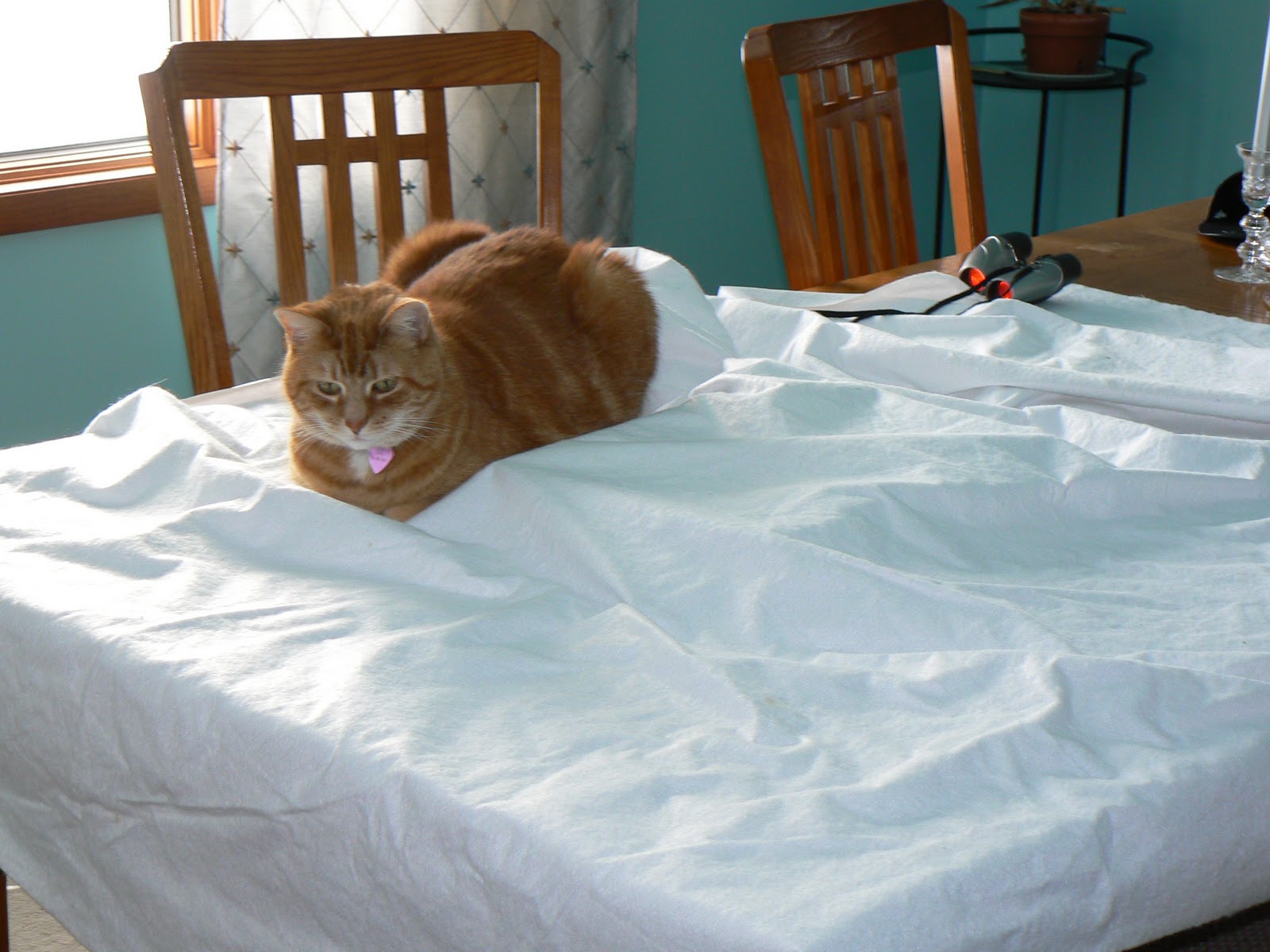
What is it about jigsaw puzzles that cats find irresistible? Every single cat I've owned has been unable to stay away from them. Okay, I get that the little pieces are fun to play with, but one cat (the late, great Antonio the Mighty Mouseslayer) would climb into the puzzle box while I was working on it, even if there were pieces in the box. Here we've covered the puzzle in progress and still Clio sits on top of it, right next to the box, as if she has to make sure no more of those tricksy pieces escape. I could just have easily chosen a picture of Gigi sitting on the puzzle, or under the puzzle table with a couple of lost pieces, looking straight at the camera with an innocent "who me?" expression. I guess it's one mystery I can't put together.
Friday, June 11, 2010
Wordless definitions: bellicose
Anyway, I noticed a few weeks ago that both cats were spending a lot of time lying on the floor a few feet from my desk, so I bought this little cat condo to make them more comfortable. Clio immediately started colonizing it, and now spends quite a bit of time there every day within easy reach of petting. Gigi isn't so forward, but she likes to sneak into the bottom hidey-hole, the better to strike at Clio when she isn't watching. You can see by her narrowed eyes that she was getting ready to attack—or would have if I hadn't stopped her. Silly cats.
Wednesday, May 26, 2010
The Word Nerd Sez: S is for...
sarsaparilla
It's really hot outside, so I'm thinking a lot about cold drinks. Iced tea and lemonade are always good, as are certain carbonated beverages. Root beer is a favorite of mine, and I know it's sometimes called sasparilla or sarsparilla; at least, that's what I remember Yosemite Sam ordering whenever he walked into a bar.
Now, the word sarsaparilla itself comes from the Spanish, a compound of the words sarsa (bush) and parilla (little vinve) and refers to various prickly vines of genus Smilax that are native to the Americas. But is it really the same as root beer? I searched the internets to see what I could find.
The answer is yes and no. Sarsaparilla was originally brewed from the Smilax plant, while root beer had its origins in the sassafras root and was sold as a medicinal drink. But many "sassparillas" were developed that used Smilax and sassafras (sassafras + sarsaparilla = sassparilla), along with other flavoring and a whole lot of sugar. Depending on the formula, root beer/sarsaparilla could also have additional flavorings, including (but not limited to) anise, cinnamon, clover, corn syrup, ginger, honey, vanilla, wintergreen, and yucca. So according to the very informative Encyclopedia Rootanica, the two drinks are essentially the same.
Now that my curiosity has been piqued, I was thinking it might be fun to try and experiment with brewing my own sarsaparilla ... except the FDA discovered in the '30s that sassafras root is a carcinogen and it's illegal to sell it. All root beers today are made with "root beer extract," which is made with artificial flavorings. There's no point in going old-fashioned if you can't go whole hog, so I'll just have to enjoy a frothy concoction someone else has brewed and bottled for me. I think a root beer float is in my near future....
Thursday, April 8, 2010
The Word Nerd Sez: R is for ...
rambunctious
There's no deep meaning behind my picking this "r" word, except that it's one of my favorite words and it was time to get back to my Word Nerd feature. Okay, I'll admit that maybe some of my tae kwon do students fall into the category of "rambunctious," and it's a much nicer word to use to describe them than "squirrelly" or "obnoxious" or "Lord, doesn't that kid ever stop?" It's also a word that aroused my curiosity, because there are no obvious clues to it's origin—no prefixes or word stubs or anything. So I headed over to my friendly Merriam-Webster site:
rambunctious: marked by uncontrollable exuberance; unruly.
Well, "uncontrollable exuberance" sure describes one of my regular students, although he's so good-natured I couldn't really describe him as unruly. "Rambunctious" is a great word to describe a lot of kids, though. (Especially since most of them don't understand what you mean when you say it, heheheh.) Anyway, let's get to the interesting part, the etymology.
rambunctious—Date: 1830; probably alteration of rumbustious (Oh, goody! An etymological scavenger hunt!)
rumbustious—Date: 1778; alteration of robustious (yippee! more definitions to chase!)
robustious—Date: c. 1548: robust; vigorous in a rough or unrefined way; boisterous (Aha! Now we come to the point!)
robust—having or showing vigor or strength, from the Latin robustus, oaken or strong, taken from the Latin robur, oak.
Now that's a path I never would have imagined for this word. It started with Latin, but altered its sound to become a word that sounds more uncontrollably exuberant than the original. Robustious sounds all Latin and stuffy (maybe one of those made-up names from Life of Brian); rambunctious sounds stubborn (like a ram) and hard to chase. Kind of like its definition. It's much more fun chasing rambunctious word origins, however, and making interesting discoveries like this one.
Thursday, February 11, 2010
The Word Nerd Asks: You banned what???
I just finished a new baby quilt, so I was thinking of putting pictures up, but then I came across this article and felt compelled to comment. I missed it when it came out a few weeks ago, but today I was perusing the very amusing, bitingly witty blog of The Rejectionist and saw this link:
It seems that a parent from a Southern California district was perturbed when they volunteered in their child's fifth-grade classroom and discovered that the Merriam-Webster Dictionary used there had a definition for oral sex. (Which, according to the M-W website, is "oral stimulation of the genitals.") Presumably the parent was concerned that Little Johnny might come home all confused and ask his mommy what "genitals" were, so they complained to the district. The district's response? Pulling all the dictionaries from their fourth- and fifth-grade classrooms.
Putting aside the questionable lessons in dictionary use this suggests—if my kid had come home asking what "genital" meant because he read it in the dictionary definition for oral sex, I would have told him to get his lazy ass back to the "G" section and look it up himself—you gotta wonder what kind of educators look at a dictionary definition and consider it "sexually graphic." The same people who then pull a book for one word, and then say "It's hard to sit and read the dictionary, but we'll be looking to find other things of a graphic nature," as a district spokeswoman did. (Hard to read the dictionary! Say it ain't so!)
The district eventually decided to reinstate the Merriam-Webster dictionary and provide an alternative one for fourth and fifth graders to use, according to the local paper, but still ... they have all kinds in California, including parents who use their spare time in their kids' class to look up dirty words in the dictionary rather than help a kid learn something.
As a side note: my version of M-W's dictionary, being older than most NFL running backs, does not have a definition for "oral sex." I did, however, look at the definition for "intercourse" and it was just filthy!
Tuesday, January 12, 2010
The Word Nerd Sez: Q is for ...
quantum
It's been shamefully long since my last Word Nerd entry, and I wish I could say it was because I was devoting myself to writing a quadrilogy, but I can't, since quadrilogy isn't even a word* and I wasn't writing one anyway. I did write an entire novel in November, as well as multiple business and biographical pieces throughout the fall, but not once during that time did I feel moved enough by the letter Q to examine a Q-word. It was a bit of a quandary, and I felt a few qualms about ignoring my Word Nerd duties, but I quashed them in order to keep working.**
Actually, I think my problem was in finding something interesting to say about a Q-word. Q words are so rare that we're familiar with most of them. (Maybe not quincunx, an arrangement of five things with four as the points of a rectangle and one in the center; try to make that in Scrabble!) To my rescue came an e-mail from A.Word.A.Day, a wonderful service that gives me a new word to contemplate at the beginning of every business day. The theme of the week was "words whose meanings have changed over time," and the word was quantum.
Quantum. Now there's a word with potential. Not only does it make me think of the most recent James Bond flick (Quantum of Solace) and thus the delectable Daniel Craig, but also about quantum physics and the uncertainty principle and not-dead-not-alive cats and all that craziness.*** And check out some of the meanings for quantum:
Ouch. My brain is starting to hurt, so I think I'll stop there, except to mention that the plural of quantum is quanta, and I hope to use that in an actual real-world sentence some day.
*A four-volume series is a tetralogy, sadly for the letter Q.
**And thank goodness I didn't use quandary or qualm, because both those word origins are "unknown," according to Webster's, and so they would have made for very short blog entries ... hey, now there's an idea!
***I read Stephen Hawking's A Brief History of Time and it made my brain hurt, but it was a good hurt, like lifting weights.
It's been shamefully long since my last Word Nerd entry, and I wish I could say it was because I was devoting myself to writing a quadrilogy, but I can't, since quadrilogy isn't even a word* and I wasn't writing one anyway. I did write an entire novel in November, as well as multiple business and biographical pieces throughout the fall, but not once during that time did I feel moved enough by the letter Q to examine a Q-word. It was a bit of a quandary, and I felt a few qualms about ignoring my Word Nerd duties, but I quashed them in order to keep working.**
Actually, I think my problem was in finding something interesting to say about a Q-word. Q words are so rare that we're familiar with most of them. (Maybe not quincunx, an arrangement of five things with four as the points of a rectangle and one in the center; try to make that in Scrabble!) To my rescue came an e-mail from A.Word.A.Day, a wonderful service that gives me a new word to contemplate at the beginning of every business day. The theme of the week was "words whose meanings have changed over time," and the word was quantum.
Quantum. Now there's a word with potential. Not only does it make me think of the most recent James Bond flick (Quantum of Solace) and thus the delectable Daniel Craig, but also about quantum physics and the uncertainty principle and not-dead-not-alive cats and all that craziness.*** And check out some of the meanings for quantum:
- A quantity or amount; a portion.
- A large amount. (think of the popular phrase quantum leap, for instance)
- The smallest amount of something that can exist independently. (think of quantum physics, which investigates the smallest particles)
Ouch. My brain is starting to hurt, so I think I'll stop there, except to mention that the plural of quantum is quanta, and I hope to use that in an actual real-world sentence some day.
*A four-volume series is a tetralogy, sadly for the letter Q.
**And thank goodness I didn't use quandary or qualm, because both those word origins are "unknown," according to Webster's, and so they would have made for very short blog entries ... hey, now there's an idea!
***I read Stephen Hawking's A Brief History of Time and it made my brain hurt, but it was a good hurt, like lifting weights.
Tuesday, October 6, 2009
The Word Nerd Wonders: What am I eating?
It's no secret that I'm a lazy cook. It's not that I don't like to cook, but the fewer steps involved in preparing a meal, the happier I am. This doesn't mean a dish has to cook quickly; I don't mind keeping an eye on the stove while something simmers or visiting the oven regularly to baste chicken, but those are things I can do while multitasking. Chopping and peeling and fileting require time and focus (it's not good to multitask when a knife is involved), plus extra dishes, and thus I do my best to avoid them.
My favorite way to cut down on cooking effort is to get meat that is pre-trimmed and pre-sliced (or cubed). Handling meat is slimy and messy and maybe-bacteria-laden, so I'd rather just take a package of pre-cubed meat and dump it in the pot. I'm not being lazy, I'm just being hygienic! This is especially crucial when I make a favorite recipe I have for pork-and-squash stew. It's really best to use fresh vegetables, so I already spend close to an hour chopping up onions and carrots and peeling and dicing potatoes and butternut squash when I make this. I really don't want to spend extra time trimming and cubing pork as well.
So on the rare occasions I make this tasty-but-time-consuming dish, I look for pre-diced pork. And one day I was at the grocery store and couldn't find it, so I asked guy working the meat department, "do you have any of that lazy-person's, er, diced pork for stew?" And the guy looked at me and said, "You mean Pork City Chicken? I think we have some over there."
I froze. PORK CITY CHICKEN? I forgot that I needed to find it for dinner; why the hell was it called PORK CITY CHICKEN? I asked the guy, and he said "that's just what we call it." (Sigh. I was hoping the butcher was a closet etymologist, but you can't find everything at Kroger.) So I picked it up and added it to my cart. PORK CITY CHICKEN, the package actually said. I took it home and began preparing stew. PORK CITY CHICKEN, the package taunted. It made no sense. It was pork, but if that was the case, why did it appear as a modifier to "City Chicken"? What was the "city" doing there at all? Did it mean something like "chicken-style pork," and if so, why not just say so? Since I didn't have to spend a lot of time with the pork, I soon stopped obsessing, looking at the mound of potatoes and squash I still had to peel.
Still, every time I bought meat for the stew it preyed upon my mind: PORK CITY CHICKEN. I made it just last week, so now, for your edification and mind, I have finally looked into the possible meaning of PORK CITY CHICKEN. While the origin hasn't been confirmed, the term "city chicken" became prominent around the time of the Depression, when chicken was more expensive than lesser cuts of pork or beef. Thrifty cooks would purchase these cheaper cuts and prepare them in a way that imitated chicken: cubed and breaded, or ground and made into the shape of a drumstick. According to the food timeline site I visited, recipes for "city chicken" seemed to be most prevalent in the Midwest, especially Pennsylvania, with appearances in Wisconsin, Michigan, and Illinois.
So there's my answer: "city chicken" means cubed mock chicken, so PORK CITY CHICKEN is "city-chicken-style pork," only with fewer letters on the package. Since Kroger is mainly local to the Midwest, someone there decided to use the old term, even though it's been nearly 80 years since the Depression. (Maybe they knew this latest downturn was coming, although chicken is now cheaper than pork, so I'm not sure that makes sense.) In any case, I have solved this "fowl" mystery, am ready to start "bacon," and hope you enjoyed coming a-loin for the ride.
My favorite way to cut down on cooking effort is to get meat that is pre-trimmed and pre-sliced (or cubed). Handling meat is slimy and messy and maybe-bacteria-laden, so I'd rather just take a package of pre-cubed meat and dump it in the pot. I'm not being lazy, I'm just being hygienic! This is especially crucial when I make a favorite recipe I have for pork-and-squash stew. It's really best to use fresh vegetables, so I already spend close to an hour chopping up onions and carrots and peeling and dicing potatoes and butternut squash when I make this. I really don't want to spend extra time trimming and cubing pork as well.
So on the rare occasions I make this tasty-but-time-consuming dish, I look for pre-diced pork. And one day I was at the grocery store and couldn't find it, so I asked guy working the meat department, "do you have any of that lazy-person's, er, diced pork for stew?" And the guy looked at me and said, "You mean Pork City Chicken? I think we have some over there."
I froze. PORK CITY CHICKEN? I forgot that I needed to find it for dinner; why the hell was it called PORK CITY CHICKEN? I asked the guy, and he said "that's just what we call it." (Sigh. I was hoping the butcher was a closet etymologist, but you can't find everything at Kroger.) So I picked it up and added it to my cart. PORK CITY CHICKEN, the package actually said. I took it home and began preparing stew. PORK CITY CHICKEN, the package taunted. It made no sense. It was pork, but if that was the case, why did it appear as a modifier to "City Chicken"? What was the "city" doing there at all? Did it mean something like "chicken-style pork," and if so, why not just say so? Since I didn't have to spend a lot of time with the pork, I soon stopped obsessing, looking at the mound of potatoes and squash I still had to peel.
Still, every time I bought meat for the stew it preyed upon my mind: PORK CITY CHICKEN. I made it just last week, so now, for your edification and mind, I have finally looked into the possible meaning of PORK CITY CHICKEN. While the origin hasn't been confirmed, the term "city chicken" became prominent around the time of the Depression, when chicken was more expensive than lesser cuts of pork or beef. Thrifty cooks would purchase these cheaper cuts and prepare them in a way that imitated chicken: cubed and breaded, or ground and made into the shape of a drumstick. According to the food timeline site I visited, recipes for "city chicken" seemed to be most prevalent in the Midwest, especially Pennsylvania, with appearances in Wisconsin, Michigan, and Illinois.
So there's my answer: "city chicken" means cubed mock chicken, so PORK CITY CHICKEN is "city-chicken-style pork," only with fewer letters on the package. Since Kroger is mainly local to the Midwest, someone there decided to use the old term, even though it's been nearly 80 years since the Depression. (Maybe they knew this latest downturn was coming, although chicken is now cheaper than pork, so I'm not sure that makes sense.) In any case, I have solved this "fowl" mystery, am ready to start "bacon," and hope you enjoyed coming a-loin for the ride.
Wednesday, September 2, 2009
The Word Nerd Sez: P is for ...
palimpsest
I thought a while about what "P" word to choose. I thought maybe palindrome, because I love playing with words, or maybe propinquity, because I can spell it but I'm not sure what it means*, but when I saw this one I had to choose it. And yes, it's another of those words that I know how to spell, and think I maybe know what it means, but when I look it up I discover I had the totally wrong idea.
For some reason, I was thinking a palimpsest was a specific poetic form, like a sonnet or a limerick or a sestina. It turns out that a palimpsest is actually a piece of paper or manuscript "which has been written on more than once, with the earlier writing incompletely erased and often legible." Now that's a word with some interest for a writer: who wouldn't like to feel like writing has some permanence, that it can travel through time and speak one mind to another, years later. Of course, in my house you usually find examples of palimpsest on old grocery lists, but still ... it's a pleasing idea, as is the secondary definition: "An object, place, or area that reflects its history."
The word origin is also interesting, from the Latin version of the Greek word palimpsestum, which means "scraped again." It's a fun reminder that writing used to involve a lot more manual labor than it does today, when a couple of keystrokes can put your ideas on a virtual page and then share them with millions thousands a couple of readers. Next time I feel like griping about the struggles of revising, I'll think of some scribe hundreds of years ago who had to scrape down a stinking animal skin just to write another copy of his master's accounts, and I'll keep quiet.
*propinquity=proximity or similarity. Sounds more interesting than it is, unfortunately.
I thought a while about what "P" word to choose. I thought maybe palindrome, because I love playing with words, or maybe propinquity, because I can spell it but I'm not sure what it means*, but when I saw this one I had to choose it. And yes, it's another of those words that I know how to spell, and think I maybe know what it means, but when I look it up I discover I had the totally wrong idea.
For some reason, I was thinking a palimpsest was a specific poetic form, like a sonnet or a limerick or a sestina. It turns out that a palimpsest is actually a piece of paper or manuscript "which has been written on more than once, with the earlier writing incompletely erased and often legible." Now that's a word with some interest for a writer: who wouldn't like to feel like writing has some permanence, that it can travel through time and speak one mind to another, years later. Of course, in my house you usually find examples of palimpsest on old grocery lists, but still ... it's a pleasing idea, as is the secondary definition: "An object, place, or area that reflects its history."
The word origin is also interesting, from the Latin version of the Greek word palimpsestum, which means "scraped again." It's a fun reminder that writing used to involve a lot more manual labor than it does today, when a couple of keystrokes can put your ideas on a virtual page and then share them with millions thousands a couple of readers. Next time I feel like griping about the struggles of revising, I'll think of some scribe hundreds of years ago who had to scrape down a stinking animal skin just to write another copy of his master's accounts, and I'll keep quiet.
*propinquity=proximity or similarity. Sounds more interesting than it is, unfortunately.
Thursday, July 23, 2009
The Word Nerd Sez: O is for ...
obstreperous
This is one of those two-dollar words that I love to use, especially around young children—and especially to describe young children. Webster's says it means "marked by unruly or aggressive noisiness" or "stubbornly defiant or unruly." I think we've all met kids like this (not mine, of course!), and since they don't pay attention long enough for you to dazzle them with brilliance, I like to try to baffle them with bullsh— two-dollar words. "Why are you being so obstreperous!" I'll cry, and they'll usually stop what they're doing to give me a puzzled look, at least long enough for me to physically intervene in whatever mischief they're getting into. I can't claim this is a particularly effective strategy, and it's one of last resort, but it is one that's guaranteed to get one of those "you are so weird" looks that I usually get from grownups. I'm not sure why I think that's a good idea; maybe it's proof that I don't use a double standard in dealing with kids, which they usually appreciate—if they're not being obstreperous.
Anyway, about that word: there's nothing particularly unique about its origin, which is pure Latin. The prefix ob- means "against" (we see it in obstruction, obstacle, obstinate, etc.) and -strepere means "to make a clamor." (In combining these roots, don't think of it as "against clamor," but rather "against, by making a clamor.") So in addition to being very useful in describing other people's children, obstreperous is a very straightforward word, etymologically speaking. I especially like it because of the way it sounds: ob-STREP-er-ous. You can spit out the "strep" part with an amount of frustration that corresponds to the misbehavior.
I had a high school English teacher who would have told you that this expressive quality makes obstreperous a good example of onomatopoeia*. That's another two-dollar O word I really like, meaning "the naming of a thing by a vocal imitation of the sound associated with it" (such as buzz or hiss) or "the use of words whose sound suggests the sense." I still remember her fine example of onomatopoeia: nostril. "It sounds disgusting," she explained, pronouncing it with venom: "Nossss-trull. And it is disgusting!" Needless to say, this was not a big help to us seniors studying for the AP Exam, and I don't think any of us jotted this gem of a tip down. Did this make us obstreperous? I don't think so; later that year I spiked her tissue box with dry ice, creating a cloud of fog around her desk, but she didn't even notice and so there was a distinct lack of clamor involved. Sigh.
*double-checking the definition, I browsed nearby and saw the perfect O-word for this feature: onomastics, or "the sceince of study of the origins and forms of words esp. as used in a specialized field." You mean some people study this all the time, like a career? Swoon!
This is one of those two-dollar words that I love to use, especially around young children—and especially to describe young children. Webster's says it means "marked by unruly or aggressive noisiness" or "stubbornly defiant or unruly." I think we've all met kids like this (not mine, of course!), and since they don't pay attention long enough for you to dazzle them with brilliance, I like to try to baffle them with bullsh— two-dollar words. "Why are you being so obstreperous!" I'll cry, and they'll usually stop what they're doing to give me a puzzled look, at least long enough for me to physically intervene in whatever mischief they're getting into. I can't claim this is a particularly effective strategy, and it's one of last resort, but it is one that's guaranteed to get one of those "you are so weird" looks that I usually get from grownups. I'm not sure why I think that's a good idea; maybe it's proof that I don't use a double standard in dealing with kids, which they usually appreciate—if they're not being obstreperous.
Anyway, about that word: there's nothing particularly unique about its origin, which is pure Latin. The prefix ob- means "against" (we see it in obstruction, obstacle, obstinate, etc.) and -strepere means "to make a clamor." (In combining these roots, don't think of it as "against clamor," but rather "against, by making a clamor.") So in addition to being very useful in describing other people's children, obstreperous is a very straightforward word, etymologically speaking. I especially like it because of the way it sounds: ob-STREP-er-ous. You can spit out the "strep" part with an amount of frustration that corresponds to the misbehavior.
I had a high school English teacher who would have told you that this expressive quality makes obstreperous a good example of onomatopoeia*. That's another two-dollar O word I really like, meaning "the naming of a thing by a vocal imitation of the sound associated with it" (such as buzz or hiss) or "the use of words whose sound suggests the sense." I still remember her fine example of onomatopoeia: nostril. "It sounds disgusting," she explained, pronouncing it with venom: "Nossss-trull. And it is disgusting!" Needless to say, this was not a big help to us seniors studying for the AP Exam, and I don't think any of us jotted this gem of a tip down. Did this make us obstreperous? I don't think so; later that year I spiked her tissue box with dry ice, creating a cloud of fog around her desk, but she didn't even notice and so there was a distinct lack of clamor involved. Sigh.
*double-checking the definition, I browsed nearby and saw the perfect O-word for this feature: onomastics, or "the sceince of study of the origins and forms of words esp. as used in a specialized field." You mean some people study this all the time, like a career? Swoon!
Friday, June 19, 2009
The Word Nerd Sez: N is for ...
nekton
It's taken me a while to get back to my Word Nerd feature. Frankly, I wasn't inspired by the letter "N." It seemed like most N words started with prefixes: neo-, neuro-, not to mention non-. Nertz*, I thought. All these N words are namby-pamby.** So I did what I usually do when I'm stuck for a word: I started browsing the dictionary.
First thing that struck me: there are only 28 pages under the letter N, and two of those are devoted to tables. That's not very many pages; even O has more (at 31), and it doesn't even approach M (75) or the monster S section (168). But I saw some promising candidates: nectary, which is the part of a plant which produces nectar (who knew it had a name?); and negatron, which we know better as the electron and which would have given me time to expound on science and names and things.
But then I saw this word nekton. First of all, it looks cool, with that k in the middle of the word, naked without an accompanying c. (Very Greek, which is its origin ... unlike naked, which is from Middle English.) And the definition: "Free swimming aquatic animals (as in whales or squid) essentially independent of wave and current action." I didn't even know there was a word for that. Actually there are several words to classify aquatic life by their methods of locomotion (or lack thereof). There's one we've all heard of, plankton, which are those life forms that drift within the water. There's also neuston, which are those life forms that float or move on top of the water (water striders, flying fish), and benthos, those that live on the seabed, at the bottom of the ocean (bivalves, coral, anemones).
So again I read the dictionary and learn something new; not just about words, but about scientific classification. And I just know I'm going to have to use benthos in a book sometime, when I get to the Atlantis analogue I've got tucked away for future use. Nifty!
*derived from nuts!
**An eponym taken from the nickname of an 18th-century English poet.
It's taken me a while to get back to my Word Nerd feature. Frankly, I wasn't inspired by the letter "N." It seemed like most N words started with prefixes: neo-, neuro-, not to mention non-. Nertz*, I thought. All these N words are namby-pamby.** So I did what I usually do when I'm stuck for a word: I started browsing the dictionary.
First thing that struck me: there are only 28 pages under the letter N, and two of those are devoted to tables. That's not very many pages; even O has more (at 31), and it doesn't even approach M (75) or the monster S section (168). But I saw some promising candidates: nectary, which is the part of a plant which produces nectar (who knew it had a name?); and negatron, which we know better as the electron and which would have given me time to expound on science and names and things.
But then I saw this word nekton. First of all, it looks cool, with that k in the middle of the word, naked without an accompanying c. (Very Greek, which is its origin ... unlike naked, which is from Middle English.) And the definition: "Free swimming aquatic animals (as in whales or squid) essentially independent of wave and current action." I didn't even know there was a word for that. Actually there are several words to classify aquatic life by their methods of locomotion (or lack thereof). There's one we've all heard of, plankton, which are those life forms that drift within the water. There's also neuston, which are those life forms that float or move on top of the water (water striders, flying fish), and benthos, those that live on the seabed, at the bottom of the ocean (bivalves, coral, anemones).
So again I read the dictionary and learn something new; not just about words, but about scientific classification. And I just know I'm going to have to use benthos in a book sometime, when I get to the Atlantis analogue I've got tucked away for future use. Nifty!
*derived from nuts!
**An eponym taken from the nickname of an 18th-century English poet.
Friday, May 29, 2009
The Word Nerd Sez: M is for ...
Maecenas
and
menhir
Two words? you may be wondering. Or maybe just plain, What the heck language are you talking? Well, if you were watching the finals of the National Spelling Bee last night, you'd know these were the words that tripped up the second- and third-place finishers, leaving a 13-year-old Kansas girl to win with the word Laodicean (which my Webster's defines as "lukewarm or indifferent in religion or politics, taken from the reproach of the Laodiceans in Revelations).
I watched the last six rounds of the spelling bee, and I have to admit that of the last 21 words, I only could spell two of them: Caerphilly, a Welsh cheese, and guayabera, a type of Latin American shirt. Even worse, I only even recognized two of the other words that were used.
One of those words was menhir, which means "a single upright rude monolith, usually of prehistoric origin." I think I've actually seen one, near Goonhilly Downs in Cornwall, but I couldn't think of the correct spelling before the TV flashed it on the screen. If pressed, I might have gotten it, but the French origin might have thrown me.
As for Maecenas, meaning "a generous patron, especially of literature or art," I went the same way as the kid who misspelled it, starting it m-y-c- instead of m-a-e-c. I hadn't heard of this word, but I recalled the Mycenaean people of the Bronze Age Mediterranean. Maecenas is from Latin, though, so that should have been a tip-off. It would have been for the winner, who clearly knew her word derivations, and used them to get the right spelling even if she didn't recognize the word.
Perhaps if I hadn't been affected by nerves during my own middle-school spelling bee, I would have thrown myself into studying word origins and language roots. But after winning the eighth-grade division, nerves led me to stutter during the all-school bee, and say an extra letter when I didn't mean to. Tragedy! Or maybe not; now looking at words is a fun distraction for me, and not the focus of study and stress and competition. I'm amazed at all the kids who competed, and hope the love of words lasts them a lifetime.
and
menhir
Two words? you may be wondering. Or maybe just plain, What the heck language are you talking? Well, if you were watching the finals of the National Spelling Bee last night, you'd know these were the words that tripped up the second- and third-place finishers, leaving a 13-year-old Kansas girl to win with the word Laodicean (which my Webster's defines as "lukewarm or indifferent in religion or politics, taken from the reproach of the Laodiceans in Revelations).
I watched the last six rounds of the spelling bee, and I have to admit that of the last 21 words, I only could spell two of them: Caerphilly, a Welsh cheese, and guayabera, a type of Latin American shirt. Even worse, I only even recognized two of the other words that were used.
One of those words was menhir, which means "a single upright rude monolith, usually of prehistoric origin." I think I've actually seen one, near Goonhilly Downs in Cornwall, but I couldn't think of the correct spelling before the TV flashed it on the screen. If pressed, I might have gotten it, but the French origin might have thrown me.
As for Maecenas, meaning "a generous patron, especially of literature or art," I went the same way as the kid who misspelled it, starting it m-y-c- instead of m-a-e-c. I hadn't heard of this word, but I recalled the Mycenaean people of the Bronze Age Mediterranean. Maecenas is from Latin, though, so that should have been a tip-off. It would have been for the winner, who clearly knew her word derivations, and used them to get the right spelling even if she didn't recognize the word.
Perhaps if I hadn't been affected by nerves during my own middle-school spelling bee, I would have thrown myself into studying word origins and language roots. But after winning the eighth-grade division, nerves led me to stutter during the all-school bee, and say an extra letter when I didn't mean to. Tragedy! Or maybe not; now looking at words is a fun distraction for me, and not the focus of study and stress and competition. I'm amazed at all the kids who competed, and hope the love of words lasts them a lifetime.
Friday, April 24, 2009
The Word Nerd Sez: L is for ...
lagniappe
I know, I haven't written a Word Nerd post in a while. "L" just isn't that interesting a letter to me. It doesn't sound very unique—it's more of a default sound: la-la-la-la-la-la-la-la-la. "L" is a very utilitarian letter and I didn't feel like contemplating it, or even browsing through the "L" section in the dictionary. But I was feeling guilty about neglecting the blog, so I tried to think of an interesting "L" word. Then I remembered this one and I felt compelled to write about it.
Compelled, because I have a little confession to make. I can spell lagniappe with ease. I can even pronounce it without looking it up: LAN-yap. But ask me what it means? Um. Well. Is it that word I can never remember that means something about a earning a break from a job, or maybe a reward by chance, and it has a military origin and I read it in a series about a spaceship captain with an intelligent, six-legged telepathic cat?* Or was that a phrase? I can never remember.
So I decided to bring you lagniappe, because maybe this way I'll remember what it means. According to Merriam-Webster: "a small gift given a customer by a merchant at the time of a purchase; or more broadly, something given or obtained gratuitously or by way of good measure." Like an extra donut thrown into your dozen, or the little charm bracelet I got at the jeweler's when I bought TSU cufflinks for Christmas. Okay, I think I can remember that, especially when I consider this cool word origin: American French via American Spanish la ñapa, from the Quechua yapa, "something added." There aren't many English words that derive from Quechua, the language of the ancient Incas (and over 8 million present-day Andeans), only around 20 or so. Now that's memorable.
Great. Now I'll be able to define lagniappe any time I need to. Now if I can just remember that other word....
*David Weber's Honor Harrington series, great fun if you like space opera or strong heroines.
I know, I haven't written a Word Nerd post in a while. "L" just isn't that interesting a letter to me. It doesn't sound very unique—it's more of a default sound: la-la-la-la-la-la-la-la-la. "L" is a very utilitarian letter and I didn't feel like contemplating it, or even browsing through the "L" section in the dictionary. But I was feeling guilty about neglecting the blog, so I tried to think of an interesting "L" word. Then I remembered this one and I felt compelled to write about it.
Compelled, because I have a little confession to make. I can spell lagniappe with ease. I can even pronounce it without looking it up: LAN-yap. But ask me what it means? Um. Well. Is it that word I can never remember that means something about a earning a break from a job, or maybe a reward by chance, and it has a military origin and I read it in a series about a spaceship captain with an intelligent, six-legged telepathic cat?* Or was that a phrase? I can never remember.
So I decided to bring you lagniappe, because maybe this way I'll remember what it means. According to Merriam-Webster: "a small gift given a customer by a merchant at the time of a purchase; or more broadly, something given or obtained gratuitously or by way of good measure." Like an extra donut thrown into your dozen, or the little charm bracelet I got at the jeweler's when I bought TSU cufflinks for Christmas. Okay, I think I can remember that, especially when I consider this cool word origin: American French via American Spanish la ñapa, from the Quechua yapa, "something added." There aren't many English words that derive from Quechua, the language of the ancient Incas (and over 8 million present-day Andeans), only around 20 or so. Now that's memorable.
Great. Now I'll be able to define lagniappe any time I need to. Now if I can just remember that other word....
*David Weber's Honor Harrington series, great fun if you like space opera or strong heroines.
Friday, March 20, 2009
The Word Nerd Sez: K is for ...
kiwi
Kiwi fruit, that is. Yum. I'm on a bit of a fruit kick lately, as I'm trying to improve my diet (reduce cholesterol, etc.) and also lose weight for the upcoming State AAU Taekwondo Tournament. (Lower weight class=less competition, plus it's always better to be the tallest in your class rather than the smallest.) Right now I'm munching on some pineapple and honeydew. Yum. But kiwi fruit is also very tasty, as well as very convenient. All you need is to cut off the top, take a spoon, and scoop out all the tasty tasty flesh. Kiwi fruit has lots of vitamin C, almost as much potassium as a banana, as well as antioxidants and fiber. All in a tasty 45-calorie capsule that tastes a little like pineapple, but not as tart or fibrous.
It's also not in my dictionary. I was browsing the "K" section, thinking about what to write for this entry. I noticed lots of African, Yiddish, and Greek words, as well as many more "kn-" words than I would have thought. (I recognized most of them; I just didn't think there were that many.) Then "kiwi" caught my eye, with two definitions. One: a flightless New Zealand bird, genus Apteryx. (That's a very cool name, and they have it all to themselves.) Two: a native/resident of New Zealand. Nothing about the fruit, or even a separate entry for kiwi fruit.
What gives? I've been eating kiwi for twenty years now. I looked in the front matter of my Webster's, and noticed two things. First, the name inscribed there was my maiden name, written in what looks like my mother's handwriting. I'm rapidly approaching the date (sometime this summer) when I will have been married longer than I was single, so you know that's quite some time ago. I checked the copyright page: (c) 1980. Ouch. I think I need a new dictionary. There's a big old stain (of unknown origin, and I don't want to know) on the back, and it doesn't even list kiwi fruit, let alone internet or cell phone or anything about our digital age. And don't tell me I can look words up online, I know I can, but that's not as fun as browsing the pages of the dictionary. (Didn't you read my first Word Nerd post?)
Maybe Webster's can be forgiven for not including kiwi fruit in my dictionary. After all, they weren't even called that until 1960, when New Zealand growers decided they needed a better name than Chinese gooseberry. The kiwi fruit is native to China, but isn't related to the gooseberry at all. It was a good marketing decision; over a million metric tons are grown each year. The world's largest exporter of kiwi? Not New Zealand, but a country which doesn't even have the letters "k" and "w" in their alphabet: Italy. Yum. Another reason to eat Italian!
Kiwi fruit, that is. Yum. I'm on a bit of a fruit kick lately, as I'm trying to improve my diet (reduce cholesterol, etc.) and also lose weight for the upcoming State AAU Taekwondo Tournament. (Lower weight class=less competition, plus it's always better to be the tallest in your class rather than the smallest.) Right now I'm munching on some pineapple and honeydew. Yum. But kiwi fruit is also very tasty, as well as very convenient. All you need is to cut off the top, take a spoon, and scoop out all the tasty tasty flesh. Kiwi fruit has lots of vitamin C, almost as much potassium as a banana, as well as antioxidants and fiber. All in a tasty 45-calorie capsule that tastes a little like pineapple, but not as tart or fibrous.
It's also not in my dictionary. I was browsing the "K" section, thinking about what to write for this entry. I noticed lots of African, Yiddish, and Greek words, as well as many more "kn-" words than I would have thought. (I recognized most of them; I just didn't think there were that many.) Then "kiwi" caught my eye, with two definitions. One: a flightless New Zealand bird, genus Apteryx. (That's a very cool name, and they have it all to themselves.) Two: a native/resident of New Zealand. Nothing about the fruit, or even a separate entry for kiwi fruit.
What gives? I've been eating kiwi for twenty years now. I looked in the front matter of my Webster's, and noticed two things. First, the name inscribed there was my maiden name, written in what looks like my mother's handwriting. I'm rapidly approaching the date (sometime this summer) when I will have been married longer than I was single, so you know that's quite some time ago. I checked the copyright page: (c) 1980. Ouch. I think I need a new dictionary. There's a big old stain (of unknown origin, and I don't want to know) on the back, and it doesn't even list kiwi fruit, let alone internet or cell phone or anything about our digital age. And don't tell me I can look words up online, I know I can, but that's not as fun as browsing the pages of the dictionary. (Didn't you read my first Word Nerd post?)
Maybe Webster's can be forgiven for not including kiwi fruit in my dictionary. After all, they weren't even called that until 1960, when New Zealand growers decided they needed a better name than Chinese gooseberry. The kiwi fruit is native to China, but isn't related to the gooseberry at all. It was a good marketing decision; over a million metric tons are grown each year. The world's largest exporter of kiwi? Not New Zealand, but a country which doesn't even have the letters "k" and "w" in their alphabet: Italy. Yum. Another reason to eat Italian!
Tuesday, March 17, 2009
The Word Nerd Wonders: Is rebranding like an STD?
Last week was long and stressful, so I spent much of yesterday doing odds and ends, surfing the internet and cleaning up more of my office.* I was browsing through some agent blogs when I came across this on the Swivet: cable's "Sci Fi Channel" is changing their name. To Syfy.
According to the network's president, they didn't want their name to imply that they limit themselves to just one genre. The new name, which is pronounced the same as "Sci Fi," is "a broader, more open and accessible and relatable and human-friendly brand." (To hell with the cyborg audience!) "It gives us a unique word and it gives us the opportunities to imbue it with the values and the perception that we want it to have," he said.
Well, you do your best to imbue it, Mr. Network Chief, but the switch is going communicate certain values and perceptions. First, that you think television viewers are scared by a name that contains abbreviations for Science—oh no! I might have to think!—and Fiction—that's like literature! save me! (On the other hand, that might explain their increasing reliance on pro wrestling and paranormal "reality" shows in their programming, while Battlestar Galactica, one of the best and deepest shows on TV, is coming to an end.) Second, that "Sci Fi" has too much of a niche audience to be successful. I particularly enjoyed this quote from a former Sci Fi executive:
Whatever. But I think a worse, second problem awaits your new name. You obviously didn't consider the dictionary when you picked your creative spelling. If you look at the nine columns in Webster's of words that start with the letters "sy-," you'll notice all but a couple obscure ones** are pronounced with a short i. Sycamore. Syllable. Sympathy. Syncopate. Synonym. System. And my favorite (because I'm a science nerd), syzygy.***
So, Mr. Television Honcho, what is going to happen when all those new viewers you want to attract see your new name? They're going to think it sounds like "siffy." Will they think of the one word that begins with s-i-f, sift? No, my bet is they're going to think of the one word that begins with s-y-f-sound. That's right. Your shiny new network name is going to make people think of syphilis.
Well, they do say that p0rn does well during an economic downturn. Good luck with your new shows, like Battlestar Erotica, Stargate-S&M1, and co-ed p0rn wrestling. But I won't be coming out of my basement to watch.
*I mean to finish today or tomorrow, really I do.
**these include sycee, an ancient Chinese coin; sycosis, a crusty inflammation of hair follicles (ew!); and syenite, an igneous rock mainly made of feldspar.
***syzygy: the nearly straight-line configuration of three celestial bodies in a gravitational system, like our sun, moon, and the Earth during an eclipse.
According to the network's president, they didn't want their name to imply that they limit themselves to just one genre. The new name, which is pronounced the same as "Sci Fi," is "a broader, more open and accessible and relatable and human-friendly brand." (To hell with the cyborg audience!) "It gives us a unique word and it gives us the opportunities to imbue it with the values and the perception that we want it to have," he said.Well, you do your best to imbue it, Mr. Network Chief, but the switch is going communicate certain values and perceptions. First, that you think television viewers are scared by a name that contains abbreviations for Science—oh no! I might have to think!—and Fiction—that's like literature! save me! (On the other hand, that might explain their increasing reliance on pro wrestling and paranormal "reality" shows in their programming, while Battlestar Galactica, one of the best and deepest shows on TV, is coming to an end.) Second, that "Sci Fi" has too much of a niche audience to be successful. I particularly enjoyed this quote from a former Sci Fi executive:
“The name Sci Fi has been associated with geeks and dysfunctional, antisocial boys in their basements with video games and stuff like that, as opposed to the general public and the female audience in particular,” said TV historian Tim Brooks, who helped launch Sci Fi Channel when he worked at USA Network.Gee, thanks for the stereotypes! I love sci fi, and yet I'm female, socially functional, and don't live in a basement. (Okay, I admit I'm a nerd, and maybe even a geek, but still....) And about that second statement ... let's just consider the top 10 all-time US box office films: Titanic; The Dark Knight; Star Wars; Shrek 2; ET; Star Wars I: The Phantom Menace; Pirates of the Caribbean: Dead Man's Chest; Spider-Man: Star Wars III: Revenge of the Sith; and The Lord of the Rings: The Return of the King. Of those top 10 films, only one (Titanic) does not have any sci fi, fantasy, or comic book elements. It doesn't seem to me like general audiences are afraid of sci fi. Maybe he hit it on the head with the "good movie" requirement, though. When most of your original programming consists of gems like Mansquito, you probably do need a good rebranding.
Mr. Brooks said that when people who say they don’t like science fiction enjoy a film like “Star Wars,” they don’t think it’s science fiction; they think it’s a good movie.
Whatever. But I think a worse, second problem awaits your new name. You obviously didn't consider the dictionary when you picked your creative spelling. If you look at the nine columns in Webster's of words that start with the letters "sy-," you'll notice all but a couple obscure ones** are pronounced with a short i. Sycamore. Syllable. Sympathy. Syncopate. Synonym. System. And my favorite (because I'm a science nerd), syzygy.***
So, Mr. Television Honcho, what is going to happen when all those new viewers you want to attract see your new name? They're going to think it sounds like "siffy." Will they think of the one word that begins with s-i-f, sift? No, my bet is they're going to think of the one word that begins with s-y-f-sound. That's right. Your shiny new network name is going to make people think of syphilis.
Well, they do say that p0rn does well during an economic downturn. Good luck with your new shows, like Battlestar Erotica, Stargate-S&M1, and co-ed p0rn wrestling. But I won't be coming out of my basement to watch.
*I mean to finish today or tomorrow, really I do.
**these include sycee, an ancient Chinese coin; sycosis, a crusty inflammation of hair follicles (ew!); and syenite, an igneous rock mainly made of feldspar.
***syzygy: the nearly straight-line configuration of three celestial bodies in a gravitational system, like our sun, moon, and the Earth during an eclipse.
Friday, February 20, 2009
The Word Nerd Sez: J is for ...
juxtapose
Who couldn't love a word with so many funky letters in it? Look at the potential Scrabble score:
(And don't tell me it's too long for Scrabble; if you leave "POSE" open and I have letters and room, I can totally score 25 points on it, plus bonuses.) Plus, it's a word someone crabbed together from two languages: "juxta," from the Latin for "near," and "pose" (or "position") from the English. It means to place two or more things side by side, most often for purposes of comparing and contrasting. It's an essential tool to the nonfiction writer, I believe. When I'm surveying critical reaction to someone's work, I often find it useful to juxtapose positive and negative reviews. I think it gives a broad idea of what critics think, but it also gives a subtle message: take what critics think with a grain of salt; read/look/listen and judge for yourself.
One last cool thing about juxtapose/juxtaposition, I discovered this morning: it's the last word in the J section of my old Webster's Dictionary. That really makes me want to look up the last word in every section, but I have work to get back to. Darn!
*Thanks to Pholph's Scrabble Generator: What is your score? Get it here.
Who couldn't love a word with so many funky letters in it? Look at the potential Scrabble score:
![]() ![]() ![]() ![]() ![]() ![]() ![]() ![]() * |
(And don't tell me it's too long for Scrabble; if you leave "POSE" open and I have letters and room, I can totally score 25 points on it, plus bonuses.) Plus, it's a word someone crabbed together from two languages: "juxta," from the Latin for "near," and "pose" (or "position") from the English. It means to place two or more things side by side, most often for purposes of comparing and contrasting. It's an essential tool to the nonfiction writer, I believe. When I'm surveying critical reaction to someone's work, I often find it useful to juxtapose positive and negative reviews. I think it gives a broad idea of what critics think, but it also gives a subtle message: take what critics think with a grain of salt; read/look/listen and judge for yourself.
One last cool thing about juxtapose/juxtaposition, I discovered this morning: it's the last word in the J section of my old Webster's Dictionary. That really makes me want to look up the last word in every section, but I have work to get back to. Darn!
*Thanks to Pholph's Scrabble Generator: What is your score? Get it here.
Tuesday, January 20, 2009
The Word Nerd Sez: I is for ...
inauguration
I haven't been able to escape this word for the past week, and certainly not today. It's understandable; a lot of people, myself included, are excited about the new president finally taking office. Then there are the crowds! The speeches! The ball gowns! What's really piqued my interest, though, is the etymology! Hearing the word over and over made me wonder: does it mean anything that inauguration contains the word augur* in it?
After perusing the dictionary for a while, my hunch was confirmed: inauguration is from the Latin inauguratus, meaning to practice or consecrate through augury. For those of you who aren't geeks for Roman mythology and culture like I am, an augur was a diviner, someone who purported to tell the future by reading omens. Sometimes those omens were found the flight of birds, or by looking at patterns made by casting animal entrails on the ground. Some speculate that the word "augur" itself comes from the Latin avis, meaning bird. Most linguists, however, think the evidence indicates the origin is from the Latin aug-, meaning to increase or augment.
I find it fascinating that the word we use to describe the ceremonial induction of the president is related to an ancient pagan ceremony. As I read further on the subject, the augur's role wasn't really to foretell the future, but to indicate whether a decision already made would find favor with the gods. I guess that's not too different from how our democracy works. We decide who should best represent us in the government, and then pray like hell they'll do the right thing. Hopefully our new president, with the help of the Congress and even ordinary people like us, will win Fortune's favor in the coming four years. We sure could use it.
*Not to be confused with the word auger, a tool for boring holes, which derives from the Old English word for spear.
I haven't been able to escape this word for the past week, and certainly not today. It's understandable; a lot of people, myself included, are excited about the new president finally taking office. Then there are the crowds! The speeches! The ball gowns! What's really piqued my interest, though, is the etymology! Hearing the word over and over made me wonder: does it mean anything that inauguration contains the word augur* in it?
After perusing the dictionary for a while, my hunch was confirmed: inauguration is from the Latin inauguratus, meaning to practice or consecrate through augury. For those of you who aren't geeks for Roman mythology and culture like I am, an augur was a diviner, someone who purported to tell the future by reading omens. Sometimes those omens were found the flight of birds, or by looking at patterns made by casting animal entrails on the ground. Some speculate that the word "augur" itself comes from the Latin avis, meaning bird. Most linguists, however, think the evidence indicates the origin is from the Latin aug-, meaning to increase or augment.
I find it fascinating that the word we use to describe the ceremonial induction of the president is related to an ancient pagan ceremony. As I read further on the subject, the augur's role wasn't really to foretell the future, but to indicate whether a decision already made would find favor with the gods. I guess that's not too different from how our democracy works. We decide who should best represent us in the government, and then pray like hell they'll do the right thing. Hopefully our new president, with the help of the Congress and even ordinary people like us, will win Fortune's favor in the coming four years. We sure could use it.
*Not to be confused with the word auger, a tool for boring holes, which derives from the Old English word for spear.
Tuesday, January 6, 2009
The Word Nerd Sez: H is for ...
hiatus
First of all, I've got a deadline staring me in the face, so I have to take a little break from writing in this blog. So I like this word over "interruption" or "break," because it implies I'll be back. (And I will be back soon.)
Second, I like this word because of one of its alternate meanings: "the occurrence of two vowel sounds without pause or intervening consonantal sound," like in the words reality, naive, or ... hiatus.
Last, I love the etymology of the word: from the Latin hiare, which according to the Webster's site means "yawn." That's something I do a lot of, especially in days like today, when I'm trying to adjust to school schedule after enjoying vacation hours.
But don't worry, I won't ignore the blog entirely. Instead of writing, I'll be posting some of my favorite wildlife pictures from my Antarctica trip last year. It was exactly one year ago today we began our trip back from the Antarctic peninsula, and while at sea we saw a lot of sea birds like this one, a giant petrel I was lucky enough to snap mid-flight. Enjoy the pretty pictures, I'll be back writing soon.
First of all, I've got a deadline staring me in the face, so I have to take a little break from writing in this blog. So I like this word over "interruption" or "break," because it implies I'll be back. (And I will be back soon.)
Second, I like this word because of one of its alternate meanings: "the occurrence of two vowel sounds without pause or intervening consonantal sound," like in the words reality, naive, or ... hiatus.
Last, I love the etymology of the word: from the Latin hiare, which according to the Webster's site means "yawn." That's something I do a lot of, especially in days like today, when I'm trying to adjust to school schedule after enjoying vacation hours.
But don't worry, I won't ignore the blog entirely. Instead of writing, I'll be posting some of my favorite wildlife pictures from my Antarctica trip last year. It was exactly one year ago today we began our trip back from the Antarctic peninsula, and while at sea we saw a lot of sea birds like this one, a giant petrel I was lucky enough to snap mid-flight. Enjoy the pretty pictures, I'll be back writing soon.
Tuesday, December 2, 2008
The Word Nerd Sez: G is for ...
gallimaufry
I was thinking and thinking over this letter for quite some time, because there wasn't a perfect "G" word that sprang to mind. (Actually, there were several words that suggested themselves, but none seemed unique enough.) So I started browsing the dictionary ...
... whoops, got distracted for a moment there (the Latin galact- means milk!). Anyway, a couple pages in I came across this little gem of a word, which means "jumble" or "medley," from the Middle French for "hash." It's a great word to describe this particular blog entry, or the Word Nerd feature, or even this blog as a whole. Plus, this word just trips off the tongue: gal-uh-MAW-free. It sounds so fancy, but means something totally messed up. (Again, a good description of this blog.)
And to jumble things up a little more: here's some of the "G" words I considered but didn't use. Most of them are actually double-G words; I have a weakness for alliteration:
*I lie, I wasn't really contemplating this earlier. But I found this 16th-century word meaning "loose breeches" during my dictionary browse and I had to share.
I was thinking and thinking over this letter for quite some time, because there wasn't a perfect "G" word that sprang to mind. (Actually, there were several words that suggested themselves, but none seemed unique enough.) So I started browsing the dictionary ...
... whoops, got distracted for a moment there (the Latin galact- means milk!). Anyway, a couple pages in I came across this little gem of a word, which means "jumble" or "medley," from the Middle French for "hash." It's a great word to describe this particular blog entry, or the Word Nerd feature, or even this blog as a whole. Plus, this word just trips off the tongue: gal-uh-MAW-free. It sounds so fancy, but means something totally messed up. (Again, a good description of this blog.)
And to jumble things up a little more: here's some of the "G" words I considered but didn't use. Most of them are actually double-G words; I have a weakness for alliteration:
- gregarious
- gargantuan
- googolplex
- gargoyle
- gewgaw
- gingersnap
- gigantic
- galligaskins*
- gesticulate
- glockenspiel
*I lie, I wasn't really contemplating this earlier. But I found this 16th-century word meaning "loose breeches" during my dictionary browse and I had to share.
Thursday, November 6, 2008
The Word Nerd Sez: F is for ...
fumfer
I have to admit, I only discovered this word a couple of weeks ago. I was reading an article in Newsweek on the government response to the financial crisis that has been rocking the markets over the past two months. The actual quote was this:
We often borrow words from other languages that give us more exactitude than English; if you're a word nerd like me, you'd probably enjoy Adam Jacot de Boinod's The Meaning of Tingo, which is an exploration of these kinds of words that we haven't yet borrowed. If you want to know all those Eskimo words for snow, or the dozens of Somali words that describe camels, this is a fun read. Now, I've fumfered long enough in this post, so I should get back to work.
I have to admit, I only discovered this word a couple of weeks ago. I was reading an article in Newsweek on the government response to the financial crisis that has been rocking the markets over the past two months. The actual quote was this:
"Fellow citizens," Bush fumfered Friday, "we can solve this crisis—and we will." Unfortunately, his reassurances seem about as calming as the scene from "Airplane" in which the flight attendant urges everyone to remain calm while all hell breaks loose.I was immediately intrigued. I mean, Newsweek is pretty mainstream, with a fairly clear style; it's not like it's a journal written for an academic audience. And yet they used a word I didn't know ... and I'm not used to finding words I don't know in a mainstream magazine, especially not ones only six letters long. I immediately had to stop reading and go to the dictionary. And this is what I found:
Fumfer: Yiddish word meaning to "mumble", most often used to mean to be evasive; can also mean to putter aimlessly or to waste time.Wow. What a great word. Sometimes people really do mumble with the intention of being unclear, and now I know the exact word for it. Not only is it a more exact word, it's fun to say. In general, I like the feeling of many Yiddish words. Dreck, glitch, klutz, putz, schlep, schmaltz, schmooze, shtick, spiel, tchotchke, tuckus—the hard, clipped sounds of these words seem to give them extra emphasis. And it's always fun to season your vocabulary with words that have origins other than the more common French, Latin, and German.
We often borrow words from other languages that give us more exactitude than English; if you're a word nerd like me, you'd probably enjoy Adam Jacot de Boinod's The Meaning of Tingo, which is an exploration of these kinds of words that we haven't yet borrowed. If you want to know all those Eskimo words for snow, or the dozens of Somali words that describe camels, this is a fun read. Now, I've fumfered long enough in this post, so I should get back to work.
Tuesday, October 21, 2008
The Word Nerd Sez: E is for ...
epeolatry
It's funny, I'd been wondering what word I could possibly use for my "E" entry when this one popped into my e-mail box from the wonderful a.word.a.day subscription service. It's certainly appropriate to this feature, for it means "the worship of words." Now, I don't know that I "worship" words. I esteem them highly; I spend a lot of time contemplating them; I have fun playing with them. But I haven't built any altars to them ... unless you count this blog. Egads.
Anyway, I'd rather play around with words than worship them. Which leads me to a.w.a.d.'s Internet Anagram Server. Put in any phrase, and it will give you a zillion anagrams (rearrangements of the letters). Many of them are nonsense, but others can be quite amusing. I inputted my name (first and last; stick in my middle name and I get really weird stuff, lots of "zenith" and "geez," and "zit"), and it gave me over 1700 suggestions, including these that stood out:
Teenaged Nil: most teenagers feel like this, I guess, but I'm no longer a teenager (and I had a different name back then: rare naked pi!), so it doesn't count. Neither does leading teen. Aged teen nil might work, but it's not very nice.
Dental Genie: I did write a poem about the tooth fairy; "dental genie" scans much better, though.
Tanned Liege: I'm neither. Maybe if I didn't have a lineage dent, I could trace myself to royalty.
Elegant Dine: I like this one. Who doesn't like to dress up and eat out? It's certainly better than eaten dingle; that doesn't sound appetizing at all.
Genital Need: That's just wrong. But funny.
Giant Needle: Well, I do sew a lot.
Gated Eel Inn: I've got a name if I ever open a B&B!
Dang Teen Lie: Hopefully I won't encounter this soon. Ever. Hear that, Boy?
Elegant End I: Oh, good. I was worried about something ignominious, like tripping on my own underwear and suffering a fatal concussion.
Inane Get Led: Something for election season!
Need Ling Tea: I haven't heard of "ling" tea, so I must need it.
I could go on, but they just get sillier. Why don't you try it for yourself? Post your favorites in the comments.
It's funny, I'd been wondering what word I could possibly use for my "E" entry when this one popped into my e-mail box from the wonderful a.word.a.day subscription service. It's certainly appropriate to this feature, for it means "the worship of words." Now, I don't know that I "worship" words. I esteem them highly; I spend a lot of time contemplating them; I have fun playing with them. But I haven't built any altars to them ... unless you count this blog. Egads.
Anyway, I'd rather play around with words than worship them. Which leads me to a.w.a.d.'s Internet Anagram Server. Put in any phrase, and it will give you a zillion anagrams (rearrangements of the letters). Many of them are nonsense, but others can be quite amusing. I inputted my name (first and last; stick in my middle name and I get really weird stuff, lots of "zenith" and "geez," and "zit"), and it gave me over 1700 suggestions, including these that stood out:
Teenaged Nil: most teenagers feel like this, I guess, but I'm no longer a teenager (and I had a different name back then: rare naked pi!), so it doesn't count. Neither does leading teen. Aged teen nil might work, but it's not very nice.
Dental Genie: I did write a poem about the tooth fairy; "dental genie" scans much better, though.
Tanned Liege: I'm neither. Maybe if I didn't have a lineage dent, I could trace myself to royalty.
Elegant Dine: I like this one. Who doesn't like to dress up and eat out? It's certainly better than eaten dingle; that doesn't sound appetizing at all.
Genital Need: That's just wrong. But funny.
Giant Needle: Well, I do sew a lot.
Gated Eel Inn: I've got a name if I ever open a B&B!
Dang Teen Lie: Hopefully I won't encounter this soon. Ever. Hear that, Boy?
Elegant End I: Oh, good. I was worried about something ignominious, like tripping on my own underwear and suffering a fatal concussion.
Inane Get Led: Something for election season!
Need Ling Tea: I haven't heard of "ling" tea, so I must need it.
I could go on, but they just get sillier. Why don't you try it for yourself? Post your favorites in the comments.
Subscribe to:
Posts (Atom)


*