Friday, April 2, 2010

Janespotting: North by Northanger by Carrie Bebris

This is the third in the series of "Mr. and Mrs. Darcy Mysteries" that Carrie Bebris has written, inspired by various Austen novels. I thought the first, Pride and Prescience, handled the characters and the mystery quite well, while the second, Suspense and Sensibility, was less successful as a mystery, although it made good use of a couple of minor characters from Sense and Sensibility. I'm happy to say that North by Northanger (another clever title!) is my favorite in the series so far.

The novel opens with Elizabeth settling in at Pemberley, awaiting the birth of her first child and trying to figure out how make her new role as mistress of Pemberley her own. She is constantly reminded of her husband's late mother, Lady Anne, by both the house itself and the servants, and worries how to measure up. When she moves an old writing desk and discovers a letter written from Lady Anne to her future successor, it is the beginning of a mystery involving a missing family heirloom.

First, however, the Darcys head to Bath to interview a doctor who will attend the baby's birth. This gives us some good Bath scenes—filled with lots of repartee between the spouses—as well as chance to introduce Capt. Frederick Tilney into the story. Tilney sees Darcy's name in the Pump Room book and invites him to Northanger Abbey, claiming that their mothers were friends and wanting to renew the connection. The Darcys agree, but upon arriving at the Abbey find conditions very strange. There is a lack of servants—and their own attendants mysteriously disappear, and are later discovered to have been drugged—their host doesn't show up for their substandard supper; when they do meet Tilney, they find him severely injured but in good spirits, asking strange questions about their mothers and hinting at the search for a family secret.

Tilney's behavior seems especially peculiar, considering that when the Darcys mention they have found personal belongings in the late Mrs. Tilney's rooms where they have been lodged—a set of diamond jewelry, to be exact—Capt. Tilney doesn't seem interested. The reason seems clear when the Darcys cut their visit short, and within hours are accused of stealing the Tilney diamonds. The jewels are found in a clever replica of Darcy's walking stick, and Darcy is charged with the crime by an overzealous magistrate who won't consider the possibility he has been framed. He is especially disinclined to release Fitzwilliam after Henry Tilney shows up and says that Capt. Tilney died some time ago, and he never heard of the housekeeper the Darcys met.

The Darcys are forced to call on Lady Catherine de Bourgh to get him released, and she returns with them to Pemberley. Elizabeth must deal with her constant disapproval and interference, even as she goes through Lady Anne's old letters to see if there really was a friendship between her and Mrs. Tilney, and thus find some clue as to why their visit to Northanger Abbey went awry. She finds the friendship was real, and is somehow connected to Lady Anne's missing family heirloom, and she and Darcy manage to unravel all the mysteries (and thwart Lady Catherine) whilst preparing for the new baby as well.

I thought this was the best mystery of the series so far; there were no supernatural elements to cloud the mystery (Elizabeth thinking she feels Lady Anne's spirit had little to do with the mystery plot), and the connections between the Darcy family and Tilney family seemed logical. I thought Henry Tilney's character was different than how Austen portrayed him in NA—he showed none of the quirky wit that made him interesting—but then, he's introduced in a very tense situation. Other Austen characters are involved in the mystery in a very organic way, and the Darcys' relationship continues to show affection and witty banter, so that's a minor quibble. The scenes in Bath and at Northanger Abbey have much the same feel as the original Austen, as well. So I'd give this sequel—one of the very few to NA—an unqualified thumbs up.

Next up: Mansfield Park. (And yes, I meant not to use an exclamation point. Sigh.)

Thursday, April 1, 2010

2010 Book Report: First Quarter

I'm determined to do better this year at wading through my reading list; I want to hit the magic 100-book mark, an average of two books a week. Let's see how much progress I made during the first quarter.

Key: C: Children's; F: Fantasy; H: Historical; Hr: Horror; M: Mystery; MG: Middle Grade (ages 8-12); NF: Nonfiction; P: Poetry; SF: Science Fiction; SS: Short Stories; V: Verse novel; YA: Young Adult (age 13+); *not in the last ten years at least; ^read for work.

01/02/10: Philip Pullman, The Golden Compass (YA, F, 4 or 5)
01/04/10: Philip Pullman, The Subtle Knife (YA, F, 4 or 5)
01/10/10: Philip Pullman, The Amber Spyglass (YA, F, 4 or 5)
01/17/10: Jane Austen, Northanger Abbey (classic, 4 or 5)
01/23/10: Carrie Bebris, North by Northanger (M, 1)
01/27/10: Tanita S. Davis, Mare's War (YA, 1)
01/29/10: Naomi Novik, His Majesty's Dragon (F, 2)
01/31/10: Naomi Novik, Throne of Jade (F, 2)
02/15/10: Ann Radcliffe, Mysteries of Udolpho (classic, 1)
02/20/10: Sara Lewis Holmes, Operation Yes (MG, 1)
02/21/10: Elizabeth M. Hemingway, Road to Tater Hill (MG, H, 1)
02/28/10: Matthew Lewis, The Monk (classic, 1)
03/03/10: C. J. Omololu, Dirty Little Secrets (YA, 1)
03/04/10: Robert Russa Moton, Finding a Way Out^ (memoir, 1)
03/04/10: Cissy Houston, How Sweet the Sound^ (memoir, 1)
03/08/10: Art Rust, Jr., Confessions of a Baseball Junkie^ (memoir, 1)
03/13/10: Naomi Novik, Black Powder War (F, 1)
03/14/10: Horace Walpole, The Castle of Otranto (classic, 1)
03/16/10: Jane Gillespie, Uninvited Guests (H, 1)
03/19/10: Madeleine George, Looks (YA, 1)
03/23/10: Naomi Novik, Empire of Ivory (F, 1)
03/27/10: Michael Lewis, The Blind Side (NF, 1)
03/31/10: Richard Schickel, Elia Kazan: A Biography^ (NF, 1)

That's 23 books for the quarter; not quite enough to keep me on pace for my yearly target of 100 books, but pretty good, considering how much time Mysteries of Udolpho sucked out of my life. (And yes, "sucked" is the appropriate word.) I also read quite a few books for work, but only listed the ones I read all the way through.

So what was my favorite new read of the quarter? Michael Lewis's The Blind Side was just as fun as the movie—with the added bonus of more football background—and Tanita Davis's Mare's War was a really fascinating historical YA about African American women serving in WWII. But I think my favorite was Naomi Novik's Empire of Ivory, the fourth volume in her "Temeraire" series. While the series presents a really fun concept—the Napoleonic Wars, but with dragon air forces—it's great when you get further into a series and the author keeps expanding the world in ways you couldn't foresee. That's what Empire of Ivory does, taking the dragon Temeraire and his crew into Africa and presenting a really interesting variation on dragon-human culture, at the same time keeping the adventure and character development coming.

Will the fifth Temeraire book be my favorite in second quarter 2010? I guess you'll have to check back in three months to find out.

Tuesday, March 30, 2010

Cookie of the Month: Irish Lace Cookies

Last month I initiated this new feature on my blog with the Lemon Snowflake cookie, the very tasty treat I had been given for Christmas. When it was time to come up with a recipe for this month, I thought since it was almost St. Paddy's Day, and I'm just a wee bit Irish, that I would look for an Irish cookie recipe. After searching around and discarding numerous regular-cookie-dyed-green recipes, I found this traditional recipe for Irish Lace Cookies. It's pretty simple:

½ cup butter, softened
¾ cup firmly packed light brown sugar
2 T. all-purpose flour
2 T. milk
1 t. vanilla extract
1¼ cup old-fashioned rolled oats

Cream the butter with the brown sugar until the mixture is light and fluffy and beat in the flour, the milk, and the vanilla; then stir in the oats.

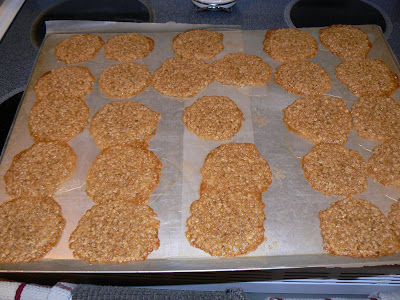
As you can see, the very small amount of flour produces a very gooey dough. You drop it onto the sheet in spoonfuls, and bake 10 to 12 minutes in a preheated 350F oven. After you take them out, you end up with something that is very flat and a little bit crispy:

Now, I pulled the recipe from the internet (usually a good source of recipes) and read through the comments. Many people had observed that these cookies were really difficult to remove from the cookies sheet, but a couple said they had used wax paper and had no trouble at all. So I topped my super-big fancy cookie sheet with some wax paper and plopped the cookie dough on top. Ungreased sheet, the recipe said. Bake until golden, the recipe said. Thus I did, and I got the following:

You probably can't tell from the picture just how devilishly the cookie is sticking to the wax paper, but it was so bad it resisted all attempts to scrape the cookie off, let alone "quickly turn the cookies upside down and roll them into cylinders." I ended up with bits of paper in my cookie, so I put the sheet back into the cooling oven to keep the cookies warm, and then scraped off crumbs a bit at a time. I took the crumbs and molded them into something resembling a cookie cylinder, and you can see the pathetic results below.

Now, these ugly-looking not-quite-cookies were actually very tasty: as you might expect, they had a strong, buttery caramel flavor from the butter and the brown sugar. But they were definitely not worth all the trouble I went through. I suppose I should try again and use a stone baking sheet instead—then I could scrape away until I had every single crumb—but April is coming soon and it's time for another new cookie. I wonder what's good for Easter...?

Final rating: nom nom (two of five noms)

Monday, March 29, 2010

Photo of the Week--3/29/10

In this installment of "Boy Terrorizes the Pigeons of Europe" ... Córdoba, Spain! It was January, 2001, and my parents and grandmother joined us again for a week-long tour of southern Europe. This time it was Spain. Imagine the six of us in a minivan—a rarity for any country in Europe—driving around some of the twisty, tiny roads of the Andalusian countryside. In Córdoba we spent time seeing the Mezquita, or great mosque, with its hundreds of columns, as well as the Roman bridge leading into the city. But we also spent time just enjoying the Mediterranean weather and torturing these pigeons, who look like they expected to be fed, not chased.

Tuesday, March 23, 2010

Janespotting: Uninvited Guests by Jane Gillespie

I've finally reached the unofficial "sequels" to Austen's Northanger Abbey, and I'm beginning with this 1994 work by Jane Gillespie. Gillespie has also produced other Austen sequels, including one to Sense and Sensibility that I enjoyed very much. So how would she approach continuing Austen's neglected satire?

She did it by revisiting three of the novel's most ridiculous characters: John and Isabella Thorpe and Captain Frederick Tilney. As it is at least 20 years since the close of NA the latter is now Colonel Tilney, but he is still vain, self-centered, and inclined to coast on his name. Although he inherited Northanger Abbey a few years ago, he hasn't spent any time there, finding the countryside boring. When he meets up with John Thorpe in Bath, he takes his old acquaintance's word that the Abbey is in need of repairs, and takes him up on his offer to oversee the work.

Of course, if he had been as familiar with John Thorpe as we are, he would have known the man was prone to exaggeration and just as unlikely to do any real work as he was to tell the truth. But by Chapter 3, Thorpe is ensconced at the Abbey, where his sister Isabella, the impoverished widow Firth, soon joins him, having been turned out of her other siblings' homes. After throwing over James Morland because he wasn't as rich as she had thought, Isabella married a wealthy scion of a Scottish family; she only discovered after the wedding that he had been disinherited. Now she waits for her son Roland to finish his schooling and help support her. Roland, however, feels obligated to continue tutoring the young Charles Ballard, the crippled (but treasured) son of an industrialist. When Isabella decides she must have her son's company, both he and Charles join the group at Northanger Abbey.

The party is complete when Colonel Tilney's daughter Paulina arrives, along with her "uncle" James Morland, a reverend. Hijinks ensue: Thorpe's attempts at uncovering and rebuilding the Abbey's old chapel are increasingly ridiculous; Charles decides to explore an underground passage by himself, injuring his one good hand; and Isabella, once she finally recognizes the bearded James, makes another play for him—at least, until Paulina is called to join her family because her mother is deathly ill. Then Isabella envisions herself as the future mistress of the Abbey—she caught Tilney's attention once before, didn't she?—and ignores him forthwith. The only people who act sensibly are Roland and Paulina, who of course fall in love.

Things come to a head when the Colonel finally discovers what has been going on at the Abbey, and rushes back with Paulina to put a stop to it. He is ready to have Thorpe arrested, but Isabella provides proof the Colonel gave permission, and the situation is defused by Charles's practical father, who also joined the party. Still, it means all the "uninvited guests" must leave: Thorpe to his own unfinished project; Isabella to another sibling's house (still unwed, as the Colonel's wife recovered her health and James Morland his senses); and Roland and Charles to the seaside. All that remains is to remove any obstacles between the young lovers, and these are solved when Roland receives a letter informing him that he has come into a large trust fund from his late grandfather.

The plot isn't anything spectacular, but the fun lies in the way the author uses the characters, especially Thorpe and Isabella. They are so clueless about their own ridiculousness that it's a lot of fun to read about them even if they're not doing very much. So even though the tone of the novel is completely different from Austen's original, this sequel gets a thumb's up from me.

Monday, March 22, 2010

Photo of the Week--3/22/10

Why didn't we find any pigeons during our visit to Istanbul? Was it because it was December and it was cold, or was it because of fat, sassy cats like this one? We walked around a lot during that weekend and here found a real-life version of a Lesley Anne Ivory painting. This kitty was pretty comfortable on the carpet, even with Boy tickling her ears.

Thursday, March 18, 2010

Wordless definitions: abundance

Actually, I considered using this picture for the definition "envy," because any time my mom sees how my orchids are doing she complains that her plants don't bloom like mine do. As you can see on the bottom shelf, all three of my phalaenopsis orchids have inflorescences (stems with blossoms), and plenty of them. Old Faithful on the far right, which I bought at Sam's Club of all places, blooms every year with several flowers and this year is giving me a ridiculous four branches on the same stem. My newest phalaenopsis (the one in the middle), if you look near the bamboo stalk pointing up, has a couple of buds on its stem. And you probably can't see that the phalaenopsis on the left has a second stem parallel to the floor, in addition to the one that's grown vertically to the shelf above it. Because phalaenopsis blooms usually last several weeks in my house, I'm going to have a ton of blooms soon.

Of course, the flowers that really got me excited belong to the laeliocattleya (an artificial hybrid of cattleyas) on the top shelf. Not only is it a gorgeous color, but cattleyas and their hybrids have also proven harder for me to get to bloom at home. I usually buy one in bloom, and then it sits there for a few years, stubbornly withholding blossoms, often until it withers and dies. (Mortality rate for cattleyas in my house is not good; they are not as idiot-proof as phalaenopses, unfortunately.) But this one I bought last spring, so the fact that it's blooming a year later is cause for celebration. The blooms won't last as long, but it's enough to bring some cheer into my flowerless March.