
Friday, May 7, 2010
Wordless definitions: greedy
I've mentioned before that orchids really like the greenhouse window TSU installed in my kitchen, and rewarded me with loads and loads of blossoms this spring. My three phaelenopses are in full bloom right now, one with about two dozen flowers, and one of my stubborn cattleyas even bloomed. So although I wasn't lacking blooms when I attended a local orchid show, I wasn't lacking extra space in my window, either. I spent a few minutes looking at the displays, but I was more interested in the sales room. I really had trouble choosing. There was this lovely phaelenopsis, white with just a blush of pink in the center ... and phaelenopsis are almost idiot-proof, so it would be a good investment. But then there was this gorgeous white cattleya with raspberry stripes ... and it had a gorgeous scent! But then the phaelenopsis was on sale! But the cattleya was so pretty! You can see my final decision, and why it suits our wordless definition:
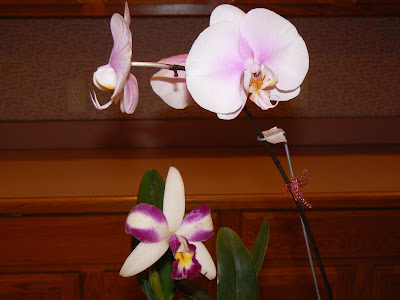 When it comes to orchids, I can't help being greedy.

Thursday, May 6, 2010
The Quilt Files, Episode 19
So I'd gotten into the pattern of making a baby quilt whenever someone was expecting, and I planned to revisit one of my favorite patterns when a cousin announced she was expecting baby #2. As I was planning the quilt, I began to think about baby #1, who was born before I started quilting. Her sibling was getting a quilt; her twin cousins already had quilts; why should she be denied a quilt just because she was born first?


She was five or six at the time, so I figured I could make a nice lap quilt, in pretty girl colors, from some of the fabric in my stash. (I might have bought a couple of fat quarters, but I think I mostly used stash fabrics.) As a bonus, I would put something pretty and girly on it ... and you don't get much more girly than fairies! I found some images in Microsoft ClipArt, blew them up big, and then used them to create appliques, which I basted on to the base and then attached with a satin stitch around the edges. I finished by quilting concentrically around the fairies, using the center one for my main circle and putting smaller circles around the corner fairies. I think it turned out nicely. The little girl in me certainly thought it was pretty pretty pretty!
Sometimes I have just as much fun putting together the back of a quilt. I had found this gorgeous pink and purple batik that looked almost like it had been tie-dyed. I used it for the borders and one set of squares of the top, and had this lovely big piece for the center of the back. I took the remainders of the other seven fabrics and stripped them together. It's pretty, too, and in this view you can get a better idea of how the circular quilting turned out.
I'm particularly fond of this piece; not just because I love the colors (although they are my favorites), but because I designed the whole thing myself and managed to create recognizable fairies even though I can't draw worth crap.
Tuesday, May 4, 2010
Janespotting: Ladysmead by Jane Gillespie
Like Joan Aiken, British writer Jane Gillespie wrote several Austen sequels, including ones to Northanger Abbey and Sense and Sensibility. Published in 1982, Ladysmead is her earliest effort at attempting Austen; like the other sequels, she takes one or two of the more colorful (ie, naughty) characters and drops them into a completely new situation. In this case, it is the family of Reverend Thomas Lockley, a widower who has managed to marry off five of his seven daughters. With four younger sisters already wed, the second daughter, Sophia, "felt the cage of spinsterhood beginning to enclose her," at the decrepit age of 23. She has resigned herself to managing her father's household and keeping an eye on her youngest sister, Lucinda. This proves a challenge, as the family is continually economizing, and Lucinda is depressed: her best friend has just moved away and she has few other distractions, living in the remote countryside of Lancashire.
Luckily for the story, the friends' cottage at Ladysmead is let to another set of tenants, an older widow and her niece: of course, it is Mrs. Norris and Maria Rushworth (here going by Rushton) from MP. Although she knows nothing of the scandal that led the two to leave London, Sophia is somewhat unsettled by her new neighbors: Mrs. Norris is interfering, while Maria Rushton is aloof and snobby. She finds it convenient to befriend Lucinda, however, bossing her around and encouraging her to develop a contentious attitude. She encourages her young friend to flirt with one of her father's students, even though she has no real liking for the boy. This concerns Sophia as well as her father's rector, Charles Williams. Charles has a secret devotion to Sophia, but his offers to assist her only make her angry.
When the owner of Ladysmead and the neighboring mansion passes away, his heir Mr. Dalby comes to the area to decide what to do with the property. His manners are pleasing and he makes Sophia laugh, but Mrs. Rushton decides he should be the target of Lucinda instead. Several meetings and excursions are alternately planned, thwarted, and executed, with no one satisfied with the outcome. When Mr. Dalby invites a friend to the area and he turns out to know Mrs. Rushworth's sordid history, it leads to another shock: not only does Dalby elope with Mrs. Rushton/Rushworth, but they leave the poor Mrs. Norris behind. The events disturb poor Lucinda so much that she runs away from home, seeking solace from her new friend's betrayal by visiting her old friend.
Charles follows her and discovers her, of course (shades of Mr. Darcy finding Lydia in P&P). While he is gone Rev. Lockley declare he intends to marry Mrs. Norris, giving her a home and thus freeing poor Sophia to go out into society. This shocks Sophia so much she shows her disappointment to Charles, who reveals his own feelings and offers to marry her so she can escape. When Sophia realizes his proposal is based on love and not pity, she discovers her own heart is glad for his devotion despite her mistreatment of him. She accepts him, Dalby returns to take Mrs. Norris back to Mrs. Rushworth, and all ends happily with Sophia and Charles ensconced at Ladysmead.
As I mentioned, this novel follows a similar pattern to Gillespie's other Austen sequels: an upright, steadfast, suffering heroine; one or two flawed but entertaining minor characters from Austen's original; and a virtuous hero who demonstrates his worthiness of the heroine. Is it formula? Pretty close, but since Gillespie's style is entertaining and her borrowed characters are true to the original, I don't consider that a problem—especially when the novel is less than 200 pages, making for a light, quick read. This one was fun if somewhat forgettable.
Monday, May 3, 2010
Photo of the Week--5/3/10
 Ignore the vaguely (!) suggestive statue* and look in the shadows. There you will find the scourge of pigeondom, Boy, working his magic against the fat and lazy pigeons of Helsinki. Okay, maybe Helsinki pigeons aren't that fat or lazy, as they probably work hard to acquire fat and then burn it off during the long, dark Finnish winters. But this was summer, and we had to make sure that any rest breaks those pigeons were taking didn't become a habit.
*It's the Three Smiths statue, and although the three smiths are naked, they are wielding hammers against that anvil. I just chose an unfortunate angle for this photograph.
Thursday, April 29, 2010
Cookie of the Month: Italian Easter Cookies
Yeah, yeah, I know Easter was at the beginning of April, not the end. So sue me; I haven't come up with a better method for picking out new recipes besides thinking of nearby holidays. (Coming in June: Flag Day cookies! :p) And these Italian Easter Cookies were not only extremely delicious, but lots of fun to make. The recipe:

 3. Roll dough into 1-inch thick balls. On a lightly floured surface, roll the balls out into ropes about 5 inches long. Tie into loose knots and place cookies 1 inch apart onto the prepared cookie sheet. (Note: I didn't bother with the floured surface; I made the balls, then rolled them into ropes by using my hands, and it seemed to work fine. Of course, the cookie knots look unpleasantly like dog poop, but I figured I'd get over that once they were baked.)
 4 cups confectioners' sugar

½ cup butter
¾ cup white sugar
3 eggs
1 t. vanilla extract
1 t. almond extract
¼ cup milk
¼ cup vegetable oil
3¾ cups all-purpose flour
5 t. baking powder
You can see that you end up with a dough that's a little bit sticky, similar to peanut butter cookie dough, but when rolled it actually has fewer cracks and breaks. This is probably due to the oil, and is a good thing, as you'll see from the shaping. Now the details:
1. Preheat oven to 350F and grease cookie sheets. (I used my Pampered Chef stones, which don't need greasing.)
2. In a large bowl, cream together ½ cup butter and white sugar until light and fluffy. Beat in the eggs one at a time, then stir in vanilla and almond extracts, milk, and oil. Combine the flour and baking powder, then stir into the wet mixture. (Note: I used my super duper mixer, which did a great job of mixing even dough.)
 3. Roll dough into 1-inch thick balls. On a lightly floured surface, roll the balls out into ropes about 5 inches long. Tie into loose knots and place cookies 1 inch apart onto the prepared cookie sheet. (Note: I didn't bother with the floured surface; I made the balls, then rolled them into ropes by using my hands, and it seemed to work fine. Of course, the cookie knots look unpleasantly like dog poop, but I figured I'd get over that once they were baked.)
4. Bake for 5 minutes on the bottom shelf and 5 minutes on the top shelf of the preheated oven, until the bottoms of the cookies are brown. (Note: in my oven, which tends to match times in other recipes, I needed around 7 minutes each on top and bottom to get the golden brown color.)
5. After cookies are cool, dip them in icing. Here's the recipe it called for:
 4 cups confectioners' sugar
½ cup butter, softened
1 t. vanilla extract
1 t. almond extract
3 T. milk
3-5 drops food coloring (optional)
Cream together the confectioners' sugar, butter, and vanilla and almond extracts. (You'll think this crumble couldn't possibly turn into smooth icing, but it does.) Beat in 3 T milk, one tablespoon at a time, then stir in food coloring if desired.
My frosting technique was simple: grab the cookie by the sides and dip it directly into the icing. I got good coverage that way, and a nice amount of icing. (Enough to make the cookies look less like dog turds, but not so much as to make it too sweet. Even so, I ended up with an extra cup and a half of icing.) The icing remained pretty tacky, so I made sure to use wax paper between layers of cookies in my storage container.
And the verdict? Oh, my. These were extremely tasty, much like sugar cookies, but with a super smooth texture. I actually tried one unfrosted, and it was lightly sweet, reminding me of those Stella D'Oro cookies that were advertised all the time in the 1970s. (I don't remember seeing them recently, but since they have a website I guess you can still find them. It's not like I spend time in the manufactured cookie aisle when I shop.) Frosted, they were addictive little knots; good thing Boy liked them as much as I did, or I might have eaten the whole batch by myself.
I'm already thinking about a cookie recipe for next month ... although I may have to take a break from the feature during the summer months, or I won't fit into my shorts. Maybe I'll explore the world of diet cookies? .... Naw, that's almost as wrong as having Cookie Monster call cookies a "sometimes food."
Final verdict: nom nom nom nom nom (5 of 5 noms)
Tuesday, April 27, 2010
Janespotting: The Youngest Miss Ward by Joan Aiken
Last week I read a very traditional Mansfield Park sequel written by British novelist Joan Aiken in 1984; this week I read a not-so-traditional MP prequel the same author wrote in 1998. The Youngest Miss Ward centers around the family that provides MP with three characters: Lady Bertram, Mrs. Norris, and the elder Frances Price. The novel opens as Maria Ward has secured a marriage with Sir Thomas Bertram, and her father has bestowed a relatively large dowry upon her, as befits marriage to a baronet. That leaves less than expected for Maria's other sisters: Agnes, the eldest, whom they expect to match with the cleric Mr. Norris; Frances, who is beautiful but a bit flighty; and the title character Harriet, aka Hatty, who is only twelve as the novel opens.
Hatty's life becomes a series of disappointments as her relatives keep interfering in it. When her distant cousin Lady Ursula comes to visit, she convinces the family that Hatty should be sent to her uncle rather than "tire out" her mother by reading with her all the time. Hatty isn't even allowed to return home when her mother dies; she manages to adjust to the new household anyway. She comes to enjoy her practical Aunt Polly's company, finds a sympathetic companion in her cousin Ned, and helps her disabled twin cousins develop their mental capacities, despite their nurse's disapproval. She also meets the eccentric Lord Camber, a freethinker who encourages her poetic efforts. After her aunt becomes ill, Hatty ably manages the household through a crisis as measles strikes the family. After it kills the twins, however, their nurse engineers her ouster, blaming Hatty's failure to reveal cousin Ned's affair with a local girl for their illness. Although her eldest cousin, the obnoxious Sydney, offers to marry her because she is such a good household manager, she chooses to return to her father, instead.
She is caught in a snowstorm on the way back to her father's and is forced to spend time at the cottage of the very amiable Lord Camber. She enjoys her time in his household, but the snow ends and he leaves for a social experiment in America and she heads to her father's. Her father, however, has been killed in a hunting accident, and since the property is entailed to the nearest male relative (the aforementioned Sydney), Hatty finds herself without a home once again. Lady Ursula once again provides the "solution": Hatty will go to the estate of Ursula's parents, Count and Countess Elstow, and serve as governess to their two girls.
It's an even more challenging situation for Hatty: the Count is absent, the Countess cares little about the girls; the elder girl is an egomaniac and a kleptomaniac, and the younger girl is mentally disabled (although a musical genius). Hatty is cut off from the members of her uncle's family she loves—she's not even informed when her Aunt Polly dies—and bothered by the ones she doesn't, when Sydney repeats his proposals. When the elder Elstow girl steals her poetry journal, it's the last straw. She retreats to Lord Camber's cottage, where he had invited her to stay any time, only to find Lady Ursula ensconced there, claiming she owns the title.
Still, Hatty finds ways to make herself useful, and after Lady Ursula is attacked by wasps (!) it is discovered that Lord Camber actually made over the title to Hatty. She also finds a letter from Lord Camber to her aunt (one of many letters in several epistolary sections), declaring he would like to make Hatty his wife after he returns from America. So when Lord Camber unexpectedly appears at the cottage shortly after Lady Ursula's mishap, we're all set up for the traditional romantic happy ending, right?
Wrong. Accompanying Lord Camber is a young Native American woman, whom he has married to save from tribal banishment. In another case of interference, Lady Ursula had written to his compatriot that Sydney was intending to marry Hatty. Hatty, however, makes a better ending for herself: she gets her first volume of poems published (under a male pseudonym, of course), keeps the cottage for herself, and marries Lord Camber's steward, who is a much more practical man whom she has grown to love and respect.
This was another enjoyable volume from Aiken, although in tone and plot it was much closer to the Dickensian Eliza's Daughter than the more imitative Mansfield Revisited. It reminds me that Aiken is a consistently entertaining writer, and I'm really looking forward to her Emma variation, Jane Fairfax. There are a few more MP sequels to go, as well as two or three film adaptations, so that will have to wait a while. I'm definitely planning to re-read her children's books some time in the distant future, when I finally get around to that "Diane revisits her childhood favorites" feature.
Monday, April 26, 2010
Photo of the Week--4/26/10
 As you might be able to tell from the giant sign reading "Tivoli," this photo was taken in Copenhagen, Denmark. And no, that's not a giant pigeon depicted in the fountain, it's a dragon fighting a bull. The pigeons were all in front of the fountain, located in City Hall Square, and you can see TSU helping Boy chase them. Either there were too many for Boy to take care of, or by this point he was started to tire of all the pigeon chasing. It did seem to be a Sisyphean task; no matter what city we visited it seemed there were fat pigeons needing exercise.
Subscribe to:
Posts (Atom)

