Emma was my first exposure to Austen, back in college, and at the time it didn't strike me as particularly wondrous. Sure, it had wit, but it didn't make me want to go out and read everything else Austen ever wrote. Maybe that was because I read it for a class—it's hard to really enjoy a book when you're taking notes and on a deadline—or maybe it's because I didn't fall in love with the heroine, as so many other people have. Austen sums her up in the first sentence: "Emma Woodhouse, handsome, clever, and rich, with a comfortable home and happy disposition, seemed to unite some of the best blessings of existence; and had lived nearly twenty-one years in the world with very little to distress or vex her."
Unlike Austen's other heroines, Emma does not need to worry about money or marriage, and so she occupies much of her time with matchmaking and other amusements. As the novel opens she is celebrating the marriage of her former governess to a neighboring gentlemen, although the family's close friend (and Emma's brother-in-law), Mr. Knightley, says Emma made a lucky guess, not the actual match. Undeterred, Emma tries to pair her new friend, the lovely but dubiously born Harriet Smith, with the local minister, Mr. Elton. This turns out disastrously when she discovers Mr. Elton has been wooing her, not her friend, and poor Harriet is left disappointed and distressed.
Emma spirits are only temporarily dampened; when Frank Churchill visits the neighborhood, she is ready to flirt with him and promote a match between him and Harriet. In particular, Emma enjoys speculating with Frank about the lovely Jane Fairfax, the niece of their impoverished neighbor Miss Bates; Jane is destined to support herself as a governess. Jane is lovely and musically talented (annoying Emma, who doesn't apply herself and suffers in comparison), and her reserved manner perversely inspires Emma to imagine something inappropriate behind a gift piano. Emma's behavior becomes another point of contention with Mr. Knightley, who has long been accustomed to instructing her. They both enjoy their verbal sparring matches, although Emma is put out when Mr. Knightley tells her she is spoiling Harriet.
Emma's unrestrained pursuit of amusement comes to a head one afternoon when, encouraged by Frank Churchill's flattery, she cruelly insults Miss Bates. She is crushed to see Mr. Knightley's disappointment in her, and determines to apologize and also make up her lack of attention to Jane Fairfax, whom she has come to pity. Not long after she discovers that Harriet is not aspiring to Frank Churchill, but Mr. Knightley—and that she believes he returns her affection. Emma is shocked, for she hadn't realized before that she is the only one for Mr. Knightley. One final surprise remains: after Frank Churchill's aunt dies, leaving him her fortune, it is revealed that he and Jane Fairfax have been secretly engaged. Mr. Knightley and Emma reveal their feelings to each other, and even silly Harriet ends up engaged, to the young farmer whom Emma originally thought beneath her friend's notice.
I can see why Emma is many readers' favorite Austen book. It is light-hearted and playful, like its heroine, who never has the threat of poverty or loneliness hanging over her head. Early on Emma reveals her intention never to marry, noting that "a single woman, of good fortune, is always respectable, and may be as sensible and pleasant as any body else." When you think about it, Jane Fairfax, not Emma, is more like the typical Austen heroine in situation: potentially consigned to poverty and facing many obstacles on her road to romance and happiness. I guess that's why Emma isn't one of my favorite heroines: yes, she's charming and kind, but she's also rather shallow, at least until the end of the novel. On the other hand, the secondary characters are some of Austen's best, between the over-talkative Miss Bates, the enigmatic Jane Fairfax, the obsequious grasper Mr. Elton, and his vulgar, pretentious new bride.
So for me Emma ranks somewhere in the middle of Austen's novels: I don't love it like I do Pride and Prejudice, but I'd much rather read it than Mansfield Park. Actually, how I feel about Emma depends on whether I'm feeling indulgent and playful or not. I'll be considering that playful edge more as I begin exploring all the film version of Austen's classic. Stay tuned.
Friday, March 25, 2011

Monday, March 21, 2011
Photo of the Week--3/21/11

This is one of my favorite photos from our European travels. It was taken at Ephesus in Turkey, and shows part of the Library of Celsus, a magnificent two-story building (or what remains of it) that was completed in 135AD by a Roman consul of Greek origin. Of course, in my photo you can't see the two stories, but there's something about the play of light and shadow and the angle that really gives an idea of the building's sheer, grand height. At the time this was built, Ephesus was the second-largest city in the world (behind Rome), and this was a really impressive collection of ancient buildings.
Thursday, March 17, 2011
Cookie of the Month: White-Chocolate Cherry Oatmeal Cookies
So I wasn't quite pleased with last month's Raspberry White-Chocolate Oatmeal Bars, thinking them a bit too sweet for my taste. (Astonishing, I know, that I'd find anything "too sweet.") I'd originally wanted to try using white chocolate chips in an oatmeal cookie, so when I had a little more time I went to my Better Homes & Gardens cookbook and headed to the drop cookie section. Their several variations on the Basic Drop Cookie included an oatmeal version, so I adapted it to get the following recipe:
 ¼ cup butter or margarine
¼ cup shortening
½ cup granulated sugar
¼ cup packed brown sugar
1 egg
1 teaspoon vanilla
2 tablespoons milk
1 cup all-purpose flour
½ cup dried cherries
½ cup white chocolate chips
Beat butter and shortening with electric mixer for 30 seconds. Add sugars and beat till fluffy. Add egg, vanilla, and milk; beat well. Add flour, soda, and oats to beaten mixture; mix well. Stir in dried cherries and white chocolate chips. You can see the resulting mixture is a little goopy, but full of good stuff.
 Next drop spoonfuls of batter two inches apart onto a greased cookie sheet. You can see I was pretty generous with my spoonfuls, because I have a little scooping device that is perfect for drop cookies. A heaping scoopful gives me the right amount (1-2 tablespoons) of batter, and a little squeeze of the handle slides all the batter from the scoop onto the sheet. It's much easier than the old two spoons technique, since I only need one hand to use it.
Anyway, once you've got your batter scooped, bake in a preheated 375F oven for 8 to 10 minutes. Remove and cool on a wire rack. Eat!
 And here's what they looked like after they came out of the oven and cooled a little bit. They were nice and chewy, which is how I prefer my cookies, and the mixture of flavors—oats, white chocolate, and cherry—was nice. But the balance was off; the cookies weren't very dense, and the oats seemed overpowered by everything else. So again (sigh): just a little too sweet.
Final rating: nom nom nom (three of five noms).
For now I'm giving up on white-chocolate combinations. Who knows what I'll come up with next month?
 ¼ cup butter or margarine
¼ cup shortening
½ cup granulated sugar
¼ cup packed brown sugar
1 egg
1 teaspoon vanilla
2 tablespoons milk
1 cup all-purpose flour
½ teaspoon baking soda
1 cup quick-cook oats½ cup dried cherries
½ cup white chocolate chips
Beat butter and shortening with electric mixer for 30 seconds. Add sugars and beat till fluffy. Add egg, vanilla, and milk; beat well. Add flour, soda, and oats to beaten mixture; mix well. Stir in dried cherries and white chocolate chips. You can see the resulting mixture is a little goopy, but full of good stuff.
 Next drop spoonfuls of batter two inches apart onto a greased cookie sheet. You can see I was pretty generous with my spoonfuls, because I have a little scooping device that is perfect for drop cookies. A heaping scoopful gives me the right amount (1-2 tablespoons) of batter, and a little squeeze of the handle slides all the batter from the scoop onto the sheet. It's much easier than the old two spoons technique, since I only need one hand to use it.
Anyway, once you've got your batter scooped, bake in a preheated 375F oven for 8 to 10 minutes. Remove and cool on a wire rack. Eat!
 And here's what they looked like after they came out of the oven and cooled a little bit. They were nice and chewy, which is how I prefer my cookies, and the mixture of flavors—oats, white chocolate, and cherry—was nice. But the balance was off; the cookies weren't very dense, and the oats seemed overpowered by everything else. So again (sigh): just a little too sweet.
Final rating: nom nom nom (three of five noms).
For now I'm giving up on white-chocolate combinations. Who knows what I'll come up with next month?
Monday, March 14, 2011
Photo of the Week--3/14/11

Venice is a lovely city, especially so when you get to visit and leave your kid behind, as we did in September of 2000. There's the lovely Mediterranean weather, the canals, the haphazard appearance of the buildings, and the different bridges. This one, the Ponte Tre Archi ("bridge of three arches," duh), was so intriguing I wanted to go back and forth and back through each passageway. I guess that's why they don't let the tourists drive the gondolas, though.
Thursday, March 10, 2011
The Printz Award Winners: 2010
This is the last one of these reports for a while; although the ALA recently announced the 2011 Printz winners, they're in demand in the library and it will be a while before I can get to them. I did manage to finish the 2010 books that "exemplify literary excellence in young adult literature," and here are my thoughts.
Winner:
Libba Bray, Going Bovine
Honor Books:
John Barnes, Tales of the Madman Underground: An Historical Romance, 1973
Deborah Heiligman, Charles and Emma: The Darwins’ Leap of Faith
Barnes's Madmen Underground: I wasn't wild to crack open this book, maybe because it pained me to see 1973—a year I can remember—described as "historical." (Actually, I was probably just burned out from historical research.) But once I started, I had trouble putting it down. It wasn't anything narratively unusual, just a first-person account of a boy's first week of school. But when the boy is a member of the "Madmen Underground"—a group of students put into psychological counseling throughout the years—and he has a drunk for a mother, a late father who was the town mayor, and five jobs, his struggles to find his place are compelling and fascinating. This novel is pure YA just for the voice, which was strongly opinionated, funny, and believable. This was a long book, but the pages flew by.
Heiligman's Charles and Emma: If there's anything I love more than a good story, it's a good true story. While many books have examined the life and work of Charles Darwin, author of The Origin of Species and the theory of evolution, this is the first to look at the relationship Darwin had with his wife, Emma, and how it framed and supported his work. While the writing style tends to be simple and abrupt (I do love my compound sentences), it's meticulously researched and endlessly fascinating. I would recommend this book to readers of any age who are interested in natural history and Darwin's work. (Charles and Emma also received a National Book Award honor citation.)
Rapp's Punkzilla: This is one of several YA novels by Rapp, who's also known for his stage plays, and I have to admit I didn't get it. It's an epistolary novel written by a 14-year-old military school dropout who is traveling cross-country to see his older brother, who is dying of cancer. I didn't mind the graphic language or sex, or the portrayal of the difficult times that young Jamie—street name Punkzilla—has experienced on the streets and on the road. But there's an inherent weakness in the story-through-letters format; first, everything feels very episodic (and when it doesn't, it feels very un-letter-like), and second, we can't see the denouement firsthand, when Jamie finally arrives at his brother's home. The format felt very self-conscious to me, and the climax-after-the-fact it necessitated was unsatisfying.
Yancey's The Monstrumologist: This book was a surprising inclusion on the list for me, not because it wasn't well-written—it was—but because of what type of book it was: horror, filled with suspense, lots (and I mean LOTS) of gore, and breathless plot turns. It's the kind of book I'd expect to see on the bestseller list, not an awards list. But Yancey's writing is so lush and precise, easily evoking the Victorian era of his setting, that it was a pleasure to read about his vicious, headless monsters devouring their human prey. The human characters are interesting, as well, as is the fast and twisty plot. I enjoyed it very much; it just wasn't the kind of thing I expected to see on an awards list, which doesn't usually reward popular fiction.
Bray's Going Bovine: I went into this book blind, as it was the first e-book I ever borrowed from my library and there was no cover or jacket flap to clue me in. The opening was like many a YA novel, with high-school outsider Cameron giving a funny account of his irksome days in school. But then it took a strange turn, which the title kind of gave away: the narrator discovers he has variant Creutzfeldt-Jakob Disease, better known in cattle as "mad cow disease." There's no treatment for this brain disease, which leads to growing dementia and then death, so Cameron escapes from the hospital and goes on an increasingly picaresque journey in search of a mystical cure. His adventures get wilder and wilder—involving a teenaged little person hypochondriac, a talking garden gnome which is actually the Norse god Balder, a punk angel guide, a strange cult obsessed with happiness, and possibly universe-traveling physicists. As each adventure gets weirder, we're more inclined to think they occur only in Cameron's head, and that the possibility of a "happy ending" is less likely. When I got to the end, though, it still felt satisfying, and the ride to get there was endlessly imaginative and even funny.
So, overall a pretty good year for Printz books, with a wide variety to please lots of different tastes. For now, though, my taste is going to return to Janespotting. As I said, I'm having trouble acquiring the 2011 Printz winners, and my busy schedule means I'd rather not have to read five books for one blog entry. So look next week for my review of Emma, and all the books and movies it has inspired. That should keep me busy for a while!
Winner:
Libba Bray, Going Bovine
Honor Books:
John Barnes, Tales of the Madman Underground: An Historical Romance, 1973
Deborah Heiligman, Charles and Emma: The Darwins’ Leap of Faith
Adam Rapp, Punkzilla
Rick Yancey, The Monstrumologist
Barnes's Madmen Underground: I wasn't wild to crack open this book, maybe because it pained me to see 1973—a year I can remember—described as "historical." (Actually, I was probably just burned out from historical research.) But once I started, I had trouble putting it down. It wasn't anything narratively unusual, just a first-person account of a boy's first week of school. But when the boy is a member of the "Madmen Underground"—a group of students put into psychological counseling throughout the years—and he has a drunk for a mother, a late father who was the town mayor, and five jobs, his struggles to find his place are compelling and fascinating. This novel is pure YA just for the voice, which was strongly opinionated, funny, and believable. This was a long book, but the pages flew by.
Heiligman's Charles and Emma: If there's anything I love more than a good story, it's a good true story. While many books have examined the life and work of Charles Darwin, author of The Origin of Species and the theory of evolution, this is the first to look at the relationship Darwin had with his wife, Emma, and how it framed and supported his work. While the writing style tends to be simple and abrupt (I do love my compound sentences), it's meticulously researched and endlessly fascinating. I would recommend this book to readers of any age who are interested in natural history and Darwin's work. (Charles and Emma also received a National Book Award honor citation.)
Rapp's Punkzilla: This is one of several YA novels by Rapp, who's also known for his stage plays, and I have to admit I didn't get it. It's an epistolary novel written by a 14-year-old military school dropout who is traveling cross-country to see his older brother, who is dying of cancer. I didn't mind the graphic language or sex, or the portrayal of the difficult times that young Jamie—street name Punkzilla—has experienced on the streets and on the road. But there's an inherent weakness in the story-through-letters format; first, everything feels very episodic (and when it doesn't, it feels very un-letter-like), and second, we can't see the denouement firsthand, when Jamie finally arrives at his brother's home. The format felt very self-conscious to me, and the climax-after-the-fact it necessitated was unsatisfying.
Yancey's The Monstrumologist: This book was a surprising inclusion on the list for me, not because it wasn't well-written—it was—but because of what type of book it was: horror, filled with suspense, lots (and I mean LOTS) of gore, and breathless plot turns. It's the kind of book I'd expect to see on the bestseller list, not an awards list. But Yancey's writing is so lush and precise, easily evoking the Victorian era of his setting, that it was a pleasure to read about his vicious, headless monsters devouring their human prey. The human characters are interesting, as well, as is the fast and twisty plot. I enjoyed it very much; it just wasn't the kind of thing I expected to see on an awards list, which doesn't usually reward popular fiction.
Bray's Going Bovine: I went into this book blind, as it was the first e-book I ever borrowed from my library and there was no cover or jacket flap to clue me in. The opening was like many a YA novel, with high-school outsider Cameron giving a funny account of his irksome days in school. But then it took a strange turn, which the title kind of gave away: the narrator discovers he has variant Creutzfeldt-Jakob Disease, better known in cattle as "mad cow disease." There's no treatment for this brain disease, which leads to growing dementia and then death, so Cameron escapes from the hospital and goes on an increasingly picaresque journey in search of a mystical cure. His adventures get wilder and wilder—involving a teenaged little person hypochondriac, a talking garden gnome which is actually the Norse god Balder, a punk angel guide, a strange cult obsessed with happiness, and possibly universe-traveling physicists. As each adventure gets weirder, we're more inclined to think they occur only in Cameron's head, and that the possibility of a "happy ending" is less likely. When I got to the end, though, it still felt satisfying, and the ride to get there was endlessly imaginative and even funny.
So, overall a pretty good year for Printz books, with a wide variety to please lots of different tastes. For now, though, my taste is going to return to Janespotting. As I said, I'm having trouble acquiring the 2011 Printz winners, and my busy schedule means I'd rather not have to read five books for one blog entry. So look next week for my review of Emma, and all the books and movies it has inspired. That should keep me busy for a while!
Monday, March 7, 2011
Photo of the Week--3/7/11

We traveled around England quite a bit during the summer of 2000, and Canterbury was a great place to visit. The historical cathedral, with the memorial to the matryrdom of Thomas a Becket; a Canterbury Tales attraction with re-creations of the 14th century; and this lovely building, one of my favorite kinds of places in the world: a library! We didn't see this style of building as often as you might think, because these lovely wooden facings are susceptible to fire damage. London suffered a huge fire in 1666, so there aren't many lovely wooden buildings like this any more. Just one more reason to enjoy our trip to Canterbury.
Thursday, March 3, 2011
Wordless definitions: puzzling
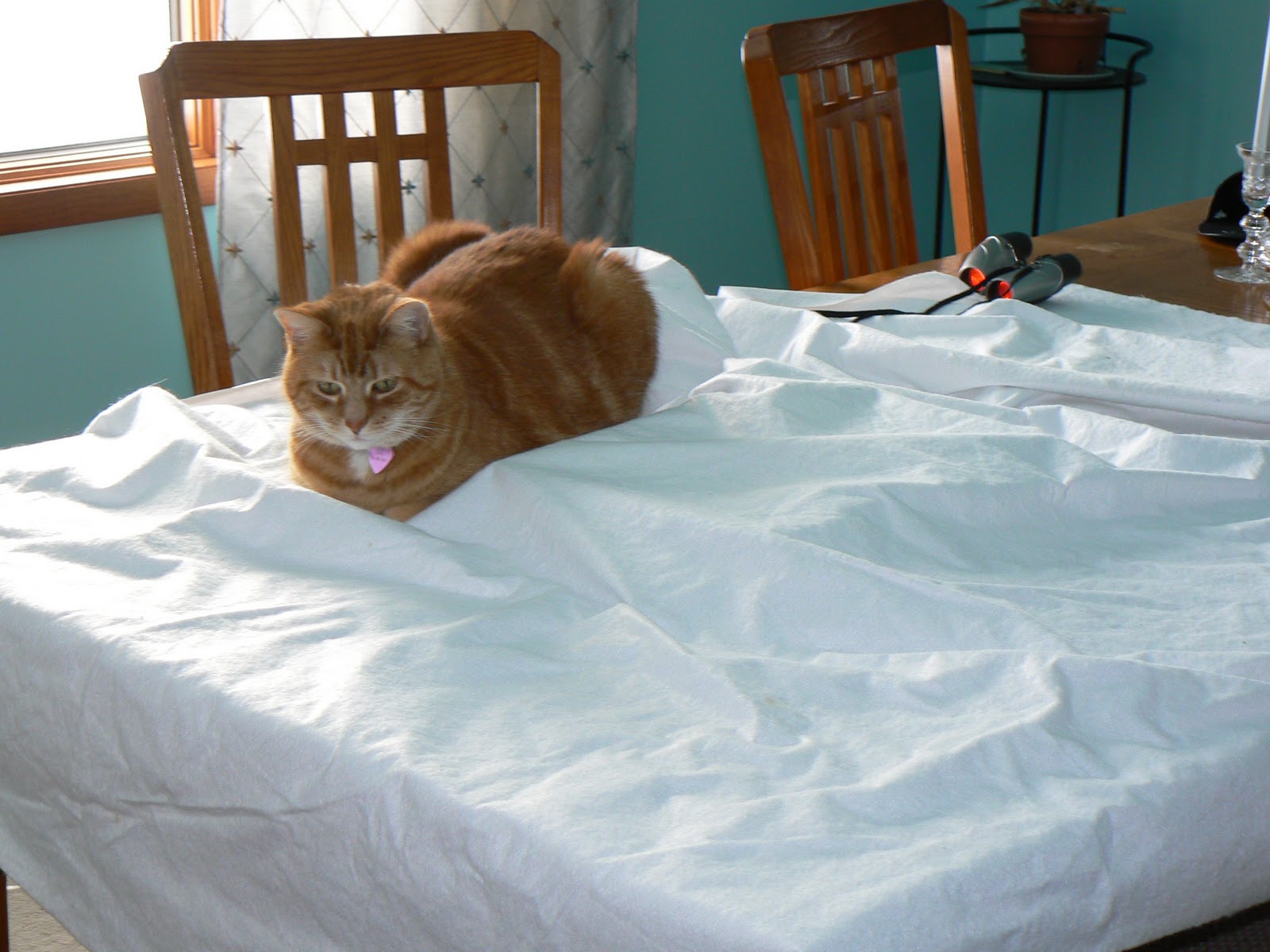
What is it about jigsaw puzzles that cats find irresistible? Every single cat I've owned has been unable to stay away from them. Okay, I get that the little pieces are fun to play with, but one cat (the late, great Antonio the Mighty Mouseslayer) would climb into the puzzle box while I was working on it, even if there were pieces in the box. Here we've covered the puzzle in progress and still Clio sits on top of it, right next to the box, as if she has to make sure no more of those tricksy pieces escape. I could just have easily chosen a picture of Gigi sitting on the puzzle, or under the puzzle table with a couple of lost pieces, looking straight at the camera with an innocent "who me?" expression. I guess it's one mystery I can't put together.
Subscribe to:
Posts (Atom)

